Segment Report
Segment North + West
The North + West segment executes construction services of nearly any kind and size with a focus on Germany, Switzerland, the Benelux countries and Scandinavia. Ground engineering can also be found in this segment.
€ mn | 6M/2025 | 6M/2024 | Δ % | Δ absolute |
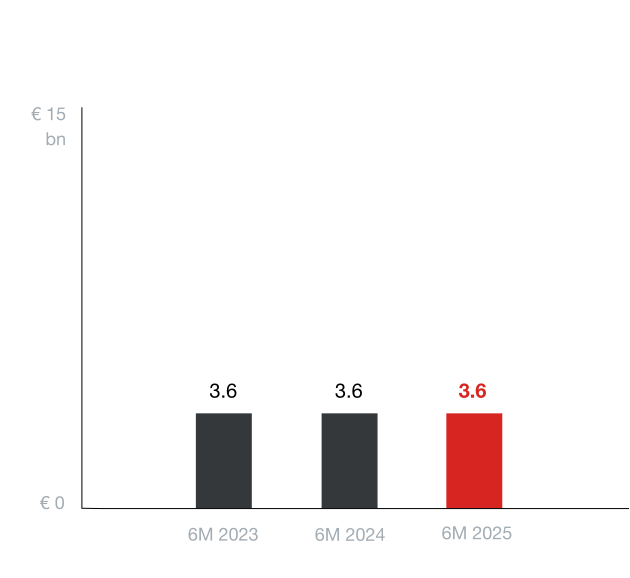
Output volume | 3,640.49 | 3,589.32 | 1 | 51 |
Revenue | 3,134.54 | 3,097.48 | 1 | 37 |
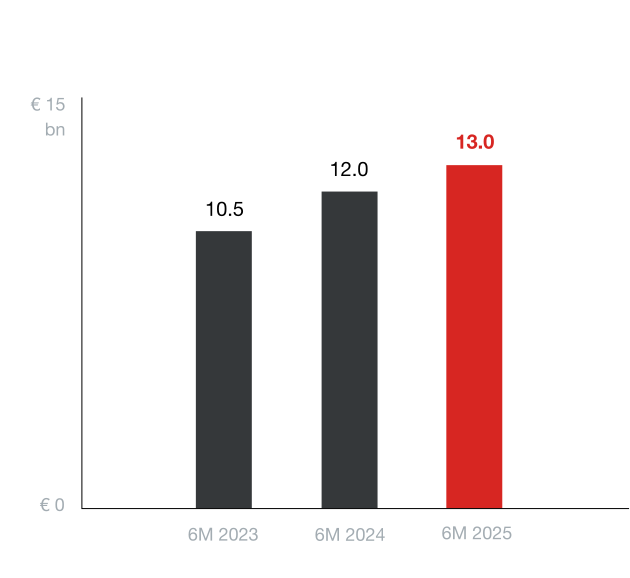
Order backlog | 12,999.89 | 12,035.28 | 8 | 965 |
EBIT | 83.38 | 65.52 | 27 | 18 |
EBIT margin (% of revenue) | 2.7 | 2.1 | ||
Employees (FTE) | 23,070 | 22,050 | 5 | 1,020 |
Output, revenue and EBIT
Output stable at high level
The North + West segment recorded stable output of € 3,640.49 million in the first half of 2025 (+1% year-on-year). While civil engineering in Germany delivered positive momentum, the preliminary federal budget has resulted in short-term project delays in transportation infrastructures, weighing on output. Building construction, meanwhile, continues to be affected by the downturn in residential construction from previous years. Growth was seen in the Benelux countries, Sweden and Switzerland, while output in Denmark declined slightly.
In line with output, revenue rose by 1%, confirming the stable business development in the North + West segment. EBIT improved significantly by 27% to € 83.38 million, mainly thanks to higher earnings contributions from German building construction.
Output volume
Order backlog
Order backlog
Order backlog continues to grow
As of 30 June 2025, the order backlog stood at € 12,999.89 million – up 8% year-on-year. This increase was driven mainly by civil engineering and energy infrastructure projects in Germany. The Benelux countries also contributed significantly to this positive development of the order backlog. Of note is a major contract awarded for the construction of 561 residential units in Amsterdam.
Employees
The number of employees in the segment increased by 5% to 23,070 FTEs. The workforce was expanded especially in Germany as a result of newly acquired major projects.
Outlook
Stable output despite a challenging environment
Thanks to a consistently high order backlog, the North + West segment is expected to deliver stable to slightly increased output in 2025 – despite the challenging market environment.
The outlook for Germany in 2025 is mixed. Following steep declines, the residential construction sector is showing early signs of a turnaround, albeit still at a low level. Declines in this sector have so far been largely offset by growth in public building construction and private industrial construction. Additional momentum is coming from medical facilities such as clinics, hospitals and laboratories, and from high-tech projects like data centres and semiconductor plants.
Despite the difficult market environment and last year’s exceptionally high output, the transportation infrastructures field in Germany remains strong. Major projects related to the energy transition and in railway construction are ensuring a stable baseline level of activity. However, the cautious approach to tendering by municipal clients – due to the still-pending approval of the 2025 federal budget – is having a short-term negative impact. If planning and approval procedures are expedited, the € 500 billion special fund pledged by the federal government could provide a significant boost to road construction demand as early as the second half of 2026.
In the Benelux countries, the market continues to be characterised by intense price competition. Here, STRABAG is pursuing its chosen path of consolidation and stabilisation in combination with a selective bidding strategy. Initial opportunities in industrial construction, particularly in projects relating to the energy transition, are being actively seized in the Netherlands and Belgium. In February 2025, STRABAG was also awarded a major contract worth around € 139 million for the "&Amsterdam" sustainable residential project.
In Scandinavia, the consolidation and stabilisation strategy is likewise being continued. Both the Danish and Swedish construction markets have recently shown early signs of recovery. The focus here is on medium-sized projects, primarily in residential, commercial and industrial construction.
Demand for construction services in Switzerland remains stable. At the same time, energy transition projects – especially the expansion of photovoltaic systems – are seeing strong growth. The Group is continuing on its growth path through targeted investments in timber construction and the sustainable production of building materials.
Segment South + East
The geographic focus of the segment South + East is on Austria, Poland, the Czech Republic, Slovakia, Hungary, Romania and South-East Europe. The construction materials activities are also handled within this segment.
€ mn | 6M/2025 | 6M/2024 | Δ % | Δ absolute |
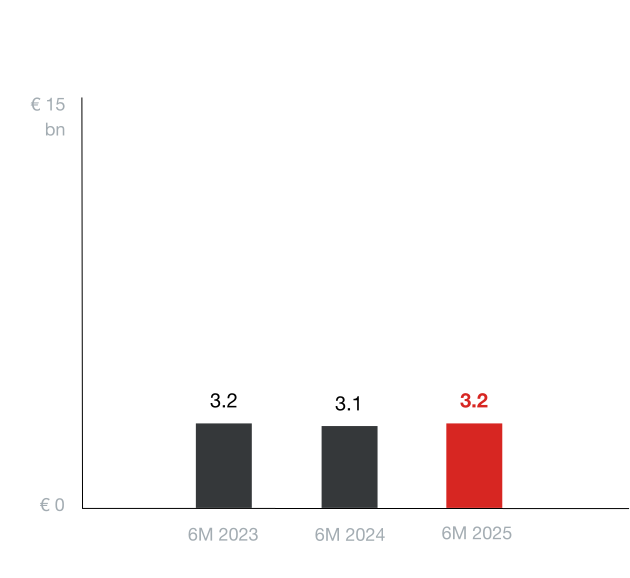
Output volume | 3,184.46 | 3,143.96 | 1 | 41 |
Revenue | 3,019.39 | 2,984.69 | 1 | 35 |
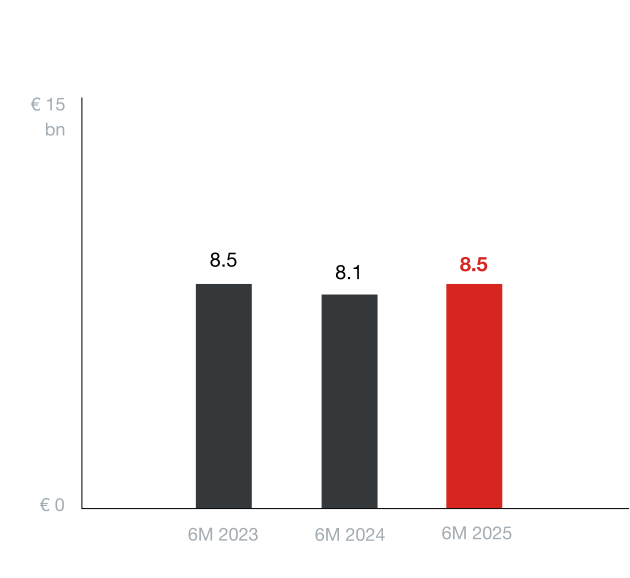
Order backlog | 8,534.95 | 8,078.81 | 6 | 456 |
EBIT | -72.21 | -45.23 | -60 | -27 |
EBIT margin (% of revenue) | -2.4 | -1.5 | ||
Employees (FTE) | 25,538 | 26,159 | -2 | -621 |
Output, revenue and EBIT
Strong output growth in Poland and Czech Republic
The South + East segment generated stable output of € 3,184.46 million in the first half of 2025 (+1% versus 6M/2024). Compared to the previous year, output increased significantly in Poland and the Czech Republic. In contrast, Austria experienced a downturn, largely driven by the lingering effects of the slump in residential construction in recent years.
Like output, revenue in the South + East segment remained stable year-on-year (+1% compared with 6M/2024). EBIT amounted to € -72.21 million in the first half of 2025, compared with € -45.23 million in the previous year. Due to seasonal effects and the higher proportion of transportation infrastructure projects, earnings in this segment are typically negative in the first half of the year. The decline is therefore primarily attributable to lower earnings contributions from road construction in individual countries.
Output volume
Order backlog
Order backlog
Significant increase driven by major projects in CEE
The order backlog as of 30 June 2025 stood at € 8,534.95 million – a clear 6% increase year-on-year. The biggest contribution by far came from the Czech Republic, where, among other things, the Group secured major new rail infrastructure projects totalling about € 360 million. Hungary, Croatia and Slovenia also significantly expanded their order books across various construction sectors.
Employees
The number of employees fell by 2% to 25,538 FTEs in the first half of 2025. In line with the output trend, staffing levels declined in Austria, while Poland and Romania saw notable increases.
Outlook
Output growth driven by strong order backlog
Starting from a high volume of orders on hand, a noticeable increase in output is expected in the South + East segment for 2025.
In Austria, building construction continues to face pressure due to the weak residential market of recent years. Residential construction began to stabilise in the first half of 2025, although growth rates remain at a relatively low level. The transportation infrastructures segment is coming under growing competitive pressure. At the same time, public tendering activity could be dampened by government austerity measures in response to the budget deficit. Providing a stabilising effect are the solid order levels in the future-facing Reconstruction, Conversion & Refurbishment business, as well as investments in energy and data networks. Specialist services and railway construction are also showing positive momentum.
In Poland, the release of EU funds from the Covid-19 recovery package is expected to revive public-sector investment. The first major projects in infrastructure, mobility, defence and the energy transition are reaching the market, though rising price and competitive pressure are becoming apparent. Private investment in building construction is currently restrained, although the recent interest rate cuts are expected to have a positive effect.
The situation in Hungary remains challenging due to withheld EU funding and a lack of public investment. Several major public-sector projects are currently on hold due to insufficient financing. A positive factor, however, are contracts awarded by the automotive manufacturing industry and its suppliers. In addition, a planned government stimulus programme is intended to boost private consumption and support the economy.
In the Czech transportation infrastructures sector – especially in railway construction – an increase in tender volumes is becoming evident. The previously intense competitive pressure in medium and large-scale projects has eased significantly. STRABAG was able to expand its order backlog considerably in the first half of 2025 and secured major railway contracts in the Czech Republic worth a total of around € 360 million. With interest rates falling, private investment is also expected to increase again.
In Slovakia, the volume of infrastructure tenders is once again growing following the formation of the new government – although most contract awards are still pending. A number of major railway construction projects are expected to be awarded. Building construction remains subdued, particularly due to stagnation in industrial and residential construction.
Demand across the markets of South-East Europe continues to develop positively, enabling STRABAG to significantly expand its order backlog in the region. In Croatia, the current focus is on transportation infrastructures and industrial construction, supported by EU-funded investment. Contracts awarded to STRABAG in the first half of 2025 include the renovation and expansion of Kranjčevićeva Stadium in Zagreb. In Slovenia, the company recently recorded a noticeable increase in building construction orders, driven in part by several successful project acquisitions. One highlight is the development and construction of the Emonika complex in Ljubljana, with a contract value exceeding € 80 million. Romania remains a promising growth market with significant infrastructure needs, some of which are being addressed through EU-funded investment. Delays in project awards are currently being caused by the political reshuffling following parliamentary elections.
The building materials activities that are bundled in the South + East segment are showing a satisfactory trend overall. These activities are of key importance for the action area of circularity in our Strategy 2030.
Segment International + Special Divisions
The International + Special Divisions segment comprises the majority of STRABAG SE’s non-European business in addition to its global tunnelling activities. The segment also encompasses infrastructure development, real estate development and building solutions, irrespective of where these are performed. The segment also includes the group divisions United Kingdom, Energy Infrastructure, and STRABAG Hold Estate (real estate portfolio management).
€ mn | 6M/2025 | 6M/2024 | Δ % | Δ absolute |
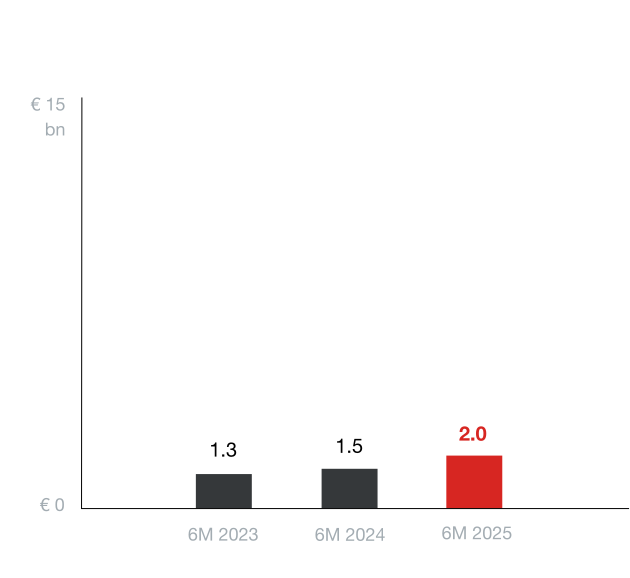
Output volume | 1,992.65 | 1,481.03 | 35 | 512 |
Revenue | 1,790.49 | 1,369.68 | 31 | 421 |
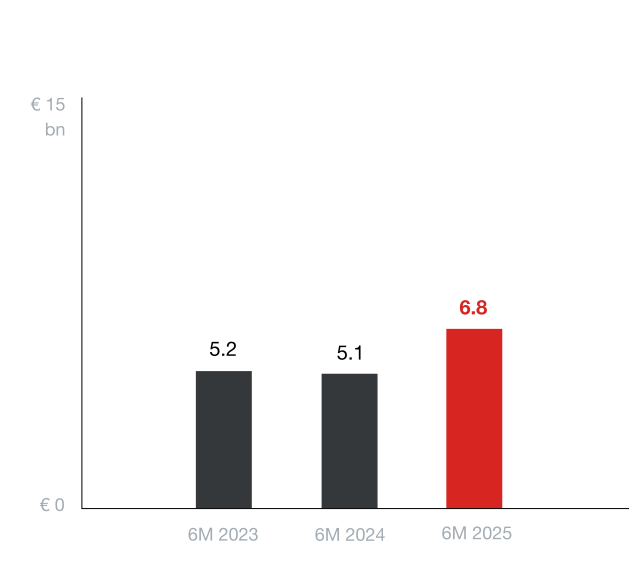
Order backlog | 6,811.49 | 5,053.19 | 35 | 1,758 |
EBIT | 126.89 | 66.62 | 90 | 60 |
EBIT margin (% of revenue) | 7.1 | 4.9 | ||
Employees (FTE) | 22,610 | 21,532 | 5 | 1,078 |
Output, revenue and EBIT
Higher output as a result of acquisition and organic growth
The International + Special Divisions segment recorded a strong 35% increase in output to € 1,992.65 million in the first six months of 2025. Roughly half of this growth stems from the acquisition of Georgiou Group in Australia, giving STRABAG a local presence there. The remaining increase reflects gains in existing markets – especially Austria, Poland and Germany, where real estate development activity expanded. In addition, Austria’s Energy Infrastructure unit and Germany’s Building Solutions business both developed positively.
Revenue in the International + Special Divisions segment rose significantly by 31% year-on-year, albeit slightly less than output. The segment is subject to regular fluctuations due to large and megaprojects. EBIT rose sharply in the first half of 2025 from € 66.62 million in the previous year to € 126.89 million. This was mainly due to higher earnings contributions from infrastructure development, the United Kingdom, the growing Building Solutions segment, and the acquisition in Australia.
Output volume
Order backlog
Order backlog
Significant increase in order backlog
As of 30 June 2025, the order backlog of the International + Special Divisions segment had risen sharply by 35% to € 6,811.49 million. Nearly two thirds of this growth came from existing markets – notably Austria, the Czech Republic and Poland. Performance varied by country, with particularly positive developments in Building Solutions, Energy Infrastructure, Real Estate Project Development and Tunnelling. The remainder of the growth stems from the acquisition in Australia.
Employees
Given the relative size of the individual projects within the International + Special Divisions segment, the number of employees generally fluctuates greatly. In the first half of 2025, this figure increased by 5% to 22,610 (FTE). In line with the output development and due to inorganic growth, more personnel were employed year-on-year, particularly in Australia, the Middle East, Austria and the Czech Republic.
Outlook
Significant output growth expected
For the full year 2025, the International + Special Divisions segment is expected to deliver a significantly higher output than in the previous year – primarily driven by the existing order backlog and the acquisition in Australia.
Due to the size of the projects, the tunnelling business is subject to regular fluctuations. Work is currently underway on major projects in Canada and the United Kingdom, where significant new contracts and contract extensions have been secured. Smaller projects have also been acquired in the Czech Republic, Slovenia, Croatia and Austria.
The focus of the international business remains on long-established markets in the Middle East and South America, with the medium-term outlook remaining positive. Decarbonisation and the energy transition in these regions, in particular, are creating promising opportunities for growth.
In the United Kingdom – where STRABAG has successfully operated in the project business for many years – the current focus is on establishing a permanent local presence. Activities are centred on infrastructure, water and energy projects, with especially strong growth prospects in the infrastructure sector.
In Australia, the integration of the Georgiou Group, acquired in March, is currently underway. The business continues to show stable market demand, although a lower number of project tenders is expected in the second half of the year. The 2032 Olympic Games in Brisbane are likely to drive construction demand between 2026 and 2030.
The Building Solutions business (formerly: Property & Facility Services) continues to expect stable performance in 2025. In addition to integrating acquired companies, the focus remains on inorganic growth through acquisitions in Austria and Germany as well as in Central and Eastern Europe. By further strengthening its expertise in M&E and energy management, the entity is developing into a full-service provider for the decarbonisation of existing buildings.
For 2025, the newly established Energy Infrastructure business – launched on 1 January 2025 in line with Strategy 2030 – is expected to benefit from continued dynamic market development. This will be driven in particular by Europe-wide efforts to meet climate targets and by national investment programmes. The business unit covers the design, construction, operation and maintenance of network infrastructure and industrial plants in the fields of electrical infrastructure, water and wastewater management, security technology, smart cities and pipeline construction. In June 2025, an agreement was signed to acquire WTE Wassertechnik GmbH. This acquisition – still subject to antitrust approval – would elevate STRABAG to the status of full-service provider for water infrastructure.
In the Infrastructure Development business, one key focus is the Haweswater Aqueduct Resilience Programme (HARP) in the UK. As part of the Group’s Strategy 2030 for the development of renewable energy, the first photovoltaic projects have been launched or put into operation in Germany and South America. Tender volumes for new concession projects in road and rail construction are developing favourably.
Real Estate Development continues to be weighed down by the weak economic environment and geopolitical instability. A marked recovery in commercial property demand is not expected before 2027. At the same time, a supply gap is emerging – particularly for sustainable properties – along with consolidation in the developer and real estate sector. Thanks to its strong development and delivery expertise for demanding sustainability and new-work concepts, STRABAG could gain competitive advantages in this area going forward.
STRABAG Hold Estate expands the Group’s portfolio by taking on long-term, strategic ownership of non-operational real estate. Five properties have been acquired to date, and further investment opportunities in the office, residential and hotel asset classes are being actively reviewed.
Segment Other
Service companies and central staff divisions
This segment encompasses the Group’s internal central divisions and central staff divisions.
€ mn | 6M/2025 | 6M/2024 | Δ % | Δ absolute |
Output volume | 87.59 | 114.98 | -24 | -27 |
Revenue | 8.18 | 10.54 | -22 | -2 |
Order backlog | 19.89 | 24.61 | -19 | -5 |
EBIT | 0.51 | 2.67 | -81 | -2 |
EBIT margin (% of revenue) | 6.2 | 25.3 | ||
Employees (FTE) | 7,941 | 7,596 | 5 | 345 |