Country report
STRABAG sees itself as a European technology group for construction services with a strong focus on Central and Eastern Europe. To diversify the country risk even further, however, and to profit from market opportunities, STRABAG operates on other continents as well. On the one hand, it is a tradition for the company to follow its clients into new markets; on the other hand, the existing country network and established organisational structures make it easier to export and use the technology in new regions with little expense.
Global economy
Growth comparison construction vs. GDP Europe
Resilient despite uncertainties
Despite persistent geopolitical and fiscal policy uncertainties, the global economy proved resilient in the reporting year, and a recession did not materialize. US tariff policy led to noticeable uncertainty in global trade, but renegotiated tariff agreements ultimately helped to mitigate the negative effects. Nevertheless, global goods flows remain under pressure, as reflected in slightly rising end-consumer prices.
Overall, global economic growth remained subdued, with momentum easing in both China and the US. Economic development in Europe continues to be muted. In particular, the consequences of the Russia–Ukraine conflict as well as Germany’s currently weak growth momentum – as the EU’s largest economy and a key export market – weighed on the outlook. By contrast, a more accommodative interest rate policy and stabilising inflation had a positive effect on the economic environment. The European Central Bank most recently lowered its key interest rate to 2% and has signalled its intention to maintain this level for the time being. In December 2025, the US Federal Reserve lowered its key interest rate for the third time this year, setting it in a range of 3.50% to 3.75%. Inflation in Europe stabilised at around 2%, supported by slightly declining energy prices, somewhat lower wage pressure and an appreciation of the euro against the US dollar.
In addition to the expected recovery in private consumption, public investment is also likely to increase. Supported by the lower interest rate environment, stabilising raw material prices and EU funding programmes – in particular NextGenerationEU – stronger public investment is anticipated in the coming years, especially in mobility, energy and defence infrastructure. National initiatives such as Germany’s € 500 billion off-budget infrastructure fund (Sondervermögen Infrastruktur) should also be mentioned in this context.
The World Bank expects global economic growth of 3.4% in 2025 and also anticipates growth of 2.2% in 2026. Global measures to combat inflation have largely been successful, even though price pressure persists in some countries. After peaking at 9.4% in the third quarter of 2022, inflation is expected to decline to 3.2% in 2025.
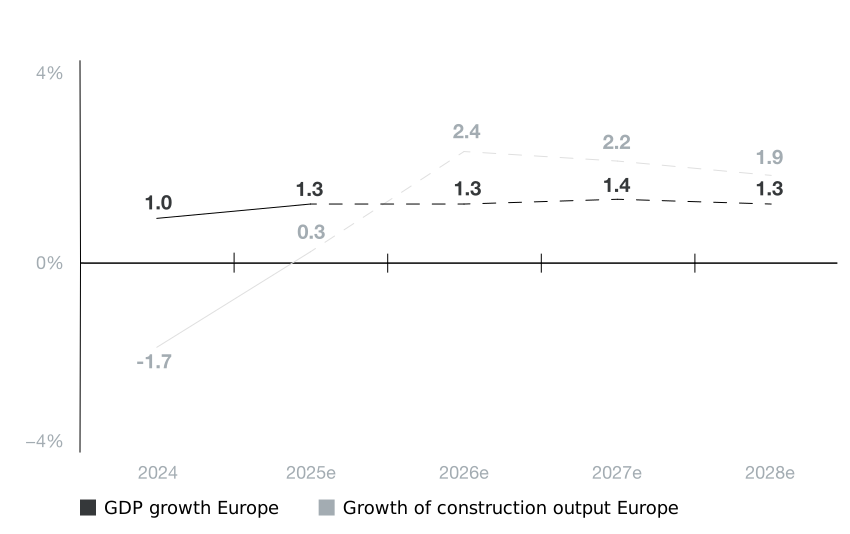
For the EU, the OECD calculated economic growth of 1.3% for 2025, with GDP in Germany and Austria virtually stagnating. GDP in the 19 Euroconstruct countries (EC-19) also rose by 1.3% in 2025. National rates vary significantly, ranging between +10.8% and 0.0%. GDP growth of 1.3% is expected for the EC-19 area in 2026, followed by 1.4% in 2027 and 1.3% in 2028.
All growth forecasts and construction volumes at the individual national level were taken from the winter 2025 reports of Euroconstruct, EECFA (Eastern European Construction Forecasting Association) and ACIF (Australian Construction Industry Forum). The stated market share data are based on figures from the 2025 financial year and on estimates for 2025 provided by Euroconstruct and EECFA.
The construction industry
Positive trends
After reaching its low point in 2024 with a decline of 1.7%, the construction industry in the EC-19 countries entered an initial recovery phase in 2025, recording a moderate increase of 0.3%. Key drivers of this development were the return to moderate overall economic growth rates, the gradual reduction of key interest rates and the stabilisation of wage, energy and material costs. This trend is further supported by funding measures at EU and national level.
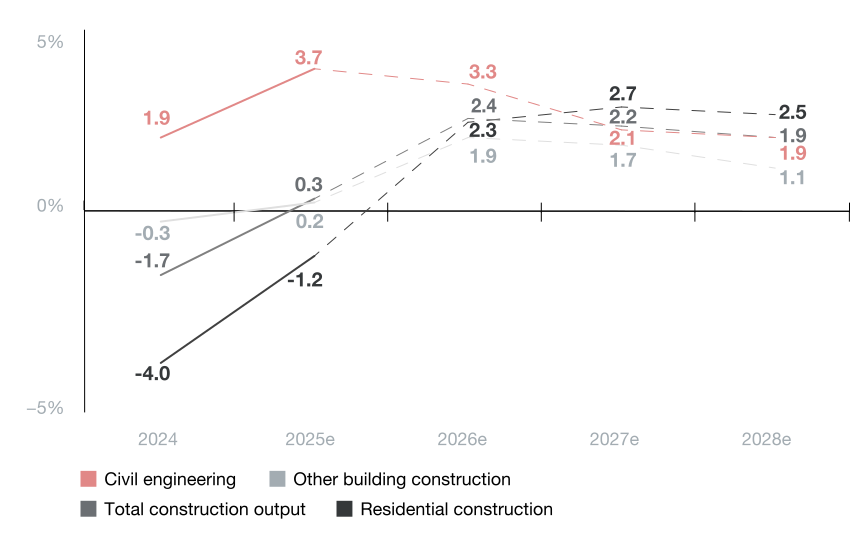
Broken down by sector, civil engineering performed strongly in 2025 and recorded the highest growth at +3.7%. Other building construction remained stable at +0.2%, while residential construction, given the prevailing environment, declined by 1.2%. This decline, however, was significantly less than in the previous year (2024: -4.0%). The strongest growth was recorded by the Irish construction industry at +8.5%, followed by Spain at +4.0% and Sweden at +3.5%. Italy ranked last at -2.7%, ahead of France and Germany (-1.4% each). In 2026, construction growth in the 19 Euroconstruct countries is expected to continue recovering, reaching +2.4%. Increases of 2.2% and 1.9% are forecast for 2027 and 2028 respectively. In STRABAG SE’s core markets in Central and Eastern Europe, the construction industry stagnated in 2025, with growth of 1.0% and 2.0% forecast for 2026 and 2027 respectively.
Construction sectors
Growth comparison of construction sectors in Europe
Civil engineering continues to have stabilising effect
Residential construction, which still accounts for nearly half of Europe’s total construction output, declined by 1.2% in 2025 to a volume of € 1,084.1 billion. Developments varied widely across countries and segments. While new-build activity declined significantly over the past two years, the renovation segment – not least due to numerous initiatives for energy-efficient refurbishment and building decarbonisation – provided a certain balancing effect overall. In absolute figures, Germany achieved the highest residential construction volume, followed by France, Italy and the United Kingdom. Positive growth was also recorded in Ireland, Hungary, Poland, Sweden and Spain, among others. The sharpest declines in residential construction were seen in Italy and Germany, followed by France, Austria and Slovakia. Euroconstruct forecasts a recovery in construction output of 2.3% in 2026. This recovery is expected to continue in 2027 with growth of 2.7% and in 2028 with an increase of 2.5% to around € 1,167 billion – slightly below the previous peak reached in 2022.
Other building construction, which accounts for around 30% of European construction volume, recorded stable growth of +0.2% in 2025. Germany is the largest market in this segment, ahead of France, the United Kingdom and Italy. The highest growth rates were recorded in Finland and Slovakia, followed by Ireland and Italy. The weakest performance in other building construction was seen in Hungary, the Netherlands, Sweden and Belgium. Euroconstruct forecasts a stronger recovery of 1.9% for the segment in 2026, with growth of 1.7% and 1.1% expected for 2027 and 2028 respectively.
Civil engineering, which contributes around 22% to European construction output, proved to be the most resilient segment in 2025, with growth of 3.7%. Germany is the largest civil engineering market, followed by Italy, the United Kingdom and France. The strongest growth was recorded in Italy, Sweden, the Czech Republic and Portugal. Slight declines and stagnation were seen only in Norway and Hungary. Growth rates of +3.3% and +2.1% are expected for European civil engineering in 2026 and 2027 respectively, with growth of 1.9% forecast for 2028.
STRABAG delivers the majority of its output in the infrastructure sector, with a focus on mobility, energy and water. Around 70% of our customers are in the public sector. Public-sector demand for infrastructure, in particular, has a stabilising effect. Residential construction accounts for less than 10% of Group output.
Developments in the core markets of STRABAG SE
Below we present the development of the national economies and of the respective construction industries in STRABAG SE’s eight core markets during the past year. These countries accounted for 84% of Group output in 2025 and their development is therefore of particular importance to STRABAG. Market positions in core markets are based on average output volume between 2022 and 2024.
Contribution to the Group output volume (%) | Overall construction volume (€ bn) | GDP growth (%) | Construction growth (%) | |||
2025 | 2025 | 2025e | 2026e | 2025e | 2026e | |
Germany | 47 | 467.7 | 0.0 | 1.0 | -1.4 | 0.5 |
The German economy stagnated in 2025, weighed down by external crises such as the conflict in Ukraine and US tariff policy. A high tax burden and strict regulatory requirements, combined with elevated energy prices, continue to put pressure on competitiveness. From 2026 onwards, however, public investment in infrastructure and defence, together with a more dynamic private consumption, should provide an economic stimulus. The easing of Germany’s strict debt brake (“Schuldenbremse”) creates additional fiscal policy scope. Euroconstruct expects growth of 1.0% in both 2026 and 2027, followed by an increase of 0.5% in 2028.
The German construction industry recorded a decline in construction output of 1.4% in 2025. While the infrastructure sector proved robust, residential construction remained under pressure as a result of the lingering effects of high interest rates and cost inflation. Provisional budgets led to project delays, particularly at municipal level, as the final budget was not adopted until September. In March 2025, in the context of easing the debt brake, the German government announced a € 500 billion off-budget fund for infrastructure and climate neutrality over a twelve-year period. The fund includes € 100 billion for the federal states and municipalities, as well as a further € 100 billion to be allocated to the Climate and Transformation Fund. Due to lengthy planning and approval procedures, initial projects from the off-budget fund are expected to be tendered only from late 2026 onwards, leading Euroconstruct to anticipate a moderate short-term increase in construction output of 0.5% in 2026, accelerating to 1.8% in 2027.
In residential construction, the decline in construction volume slowed and reached -2.4% in 2025. Despite the high demand for housing, significantly fewer new-build projects have been realised over the past four years due to high interest rates, reduced subsidies, rising costs for construction, energy and land, as well as bureaucratic hurdles. The downturn was mitigated by a more stable renovation market, particularly in the area of thermal and energy-efficient refurbishment. Supported by positive impulses such as lower interest rates, real wage growth and debureaucratisation initiatives, Euroconstruct expects stagnation in 2026, before the trend turns positive again in 2027 with growth of 2.1%.
Other building construction, which declined by 1.0% in 2025, continued to be affected by economic uncertainty and restrained investment by companies and the public sector, particularly municipalities. Rising investment in medical facilities and municipal administrative buildings, as well as a recovery in industrial and commercial construction, is expected to result in growth of 0.7% in 2026 and 1.4% in 2027.
Civil engineering recorded moderate growth of 1.0% in 2025. Delayed budget approvals dampened momentum year-on-year, while investment in rail, telecommunications and energy infrastructure provided positive impulses. Particularly in the areas of energy and water infrastructure, and as a result of the approved off-budget fund, additional medium- to long-term growth opportunities are emerging. Growth of 1.8% and 1.2% is expected for 2026 and 2027 respectively.
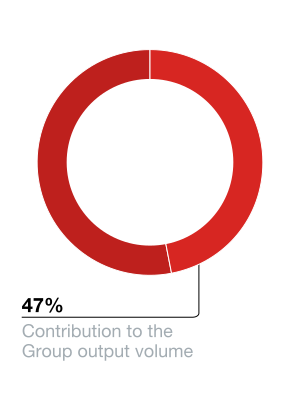
The STRABAG Group is the leading construction company in Germany, with a market share of 2.0% of the total construction volume. Around 47% (2024: 49%) of total Group output, amounting to € 9,515.82 million, was generated in Germany in 2025. With around 40,000 employees, a high level of in-house value creation and a dense construction materials network, STRABAG is very well positioned in Germany to play a key role in shaping the infrastructure modernisation drive.
Contribution to the Group output volume (%) | Overall construction volume (€ bn) | GDP growth (%) | Construction growth (%) | |||
2025 | 2025 | 2025e | 2026e | 2025e | 2026e | |
Austria | 14 | 51.4 | 0.3 | 1.1 | -0.8 | 0.2 |
After two years of recession, Austria recorded a slight economic recovery in 2025, with GDP growth of 0.3%. Dampening factors included a more restrictive fiscal policy as a result of the national budget deficit, weaker demand for export goods and a short-term spike in inflation to 3.5%. The latter resulted from the expiry of energy price caps and higher public fees. The main driver of the recovery was a noticeable increase in private consumption, supported by rising real wages and declining interest rates. For 2026, Euroconstruct forecasts growth of 1.1%, which is expected to stabilise at around 1.2% in 2027 and 2028.
The Austrian construction industry recorded a decline of 0.8% in 2025, marking a significant easing of the negative trend compared with 2024 (-5.2%). Improved financing conditions, in particular the lower interest rates, are expected to contribute to a gradual recovery in residential construction, albeit at a continued low level. At the same time, state austerity measures are likely to result in declining investment in infrastructure. This effect will be most visible at municipal level, while the state-owned motorway operator ASFINAG, which is financed through toll revenues, is maintaining its investment plans for the coming years. Euroconstruct forecasts modest growth of 0.2% in 2026, followed by increases of 1.0% and 1.1% in 2027 and 2028 respectively.
Residential construction declined by 1.6% in 2025, a significantly smaller decrease than in the previous year (2024: -6.7%). This development was driven primarily by interest rate cuts and stabilising financing costs for households and developers. However, the smaller year-on-year decline also reflects the fact that construction activity has already fallen to a considerably lower level following the sharp downturns of recent years. The renovation market provided support, growing by 2.1% on the back of sustained strong demand for energy-efficient and thermal refurbishment. Potential restrictions on subsidies as a result of fiscal consolidation could dampen renovation activity in residential construction. Continued strong demand for housing and the gradual revival of residential construction are expected to largely offset this effect, however. Growth of 0.5% and 0.9% is forecast for 2026 and 2027 respectively.
The construction volume in other building construction declined by just 0.2% in 2025, significantly less than in the previous year (-5.3%). Weak economic momentum, continued high financing costs and government austerity measures led to delays in both private and public investment. Nevertheless, Euroconstruct expects a medium-term recovery in line with macroeconomic growth and forecasts stable development in 2026 (+0.1%), followed by growth of 2.3% in 2027.
Civil engineering developed robustly in 2025, supported by government investment activity in infrastructure programmes, and grew by 0.9%. In view of a more restrictive fiscal policy, the public sector – particularly at municipal level – is likely to scale back or postpone new investments in road and water infrastructure. Major infrastructure projects, including motorway expansion schemes by ASFINAG, are expected to continue. Refurbishment and investment in energy infrastructure, supported by EU funding programmes and the national objective of stable energy prices, will remain comparatively high. Declines of 0.7% and 1.3% are forecast for 2026 and 2027 respectively.
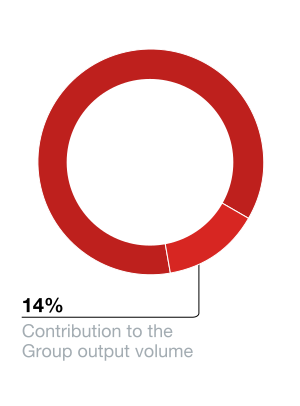
STRABAG generated 14% of Group output in Austria in 2025 (2024: 15%). Austria thus continues to rank among the Group’s top three markets alongside Germany and Poland. The output in Austria amounted to € 2,898.20 million in 2025, giving STRABAG a market share of 5.6% of the country’s total construction volume.
Contribution to the Group output volume (%) | Overall construction volume (€ bn) | GDP growth (%) | Construction growth (%) | |||
2025 | 2025 | 2025e | 2026e | 2025e | 2026e | |
Poland | 9 | 86.8 | 3.2 | 3.1 | 3.4 | 5.3 |
Poland’s economy continued to grow strongly in 2025, recording GDP growth of 3.2%. Key drivers included higher private consumption supported by rising real wages as well as increased investment activity following the release of EU funding under NextGenerationEU and the National Recovery and Resilience Plan (NRRP). Despite inflation of 3.5% and an elevated budget deficit, the market remains dynamic. Euroconstruct forecasts GDP growth of 3.1% for 2026, 3.0% in 2027 and 2.8% in 2028.
Following the transition between EU funding periods in 2023 and 2024, Poland’s construction industry recorded a marked increase of 3.4% in 2025. Despite challenges such as rising costs for construction materials, land, labour and energy – albeit at more moderate rates than in previous years – as well as the partial outflow of Ukrainian labour, positive impulses prevailed. Higher real wages supported residential construction, while released EU funds from the NRRP and NextGenerationEU boosted investment activity. Growth of 5.3% is forecast for 2026, with rates of 4.3% expected in both 2027 and 2028.
In contrast to the European trend, Poland’s residential construction sector recorded strong growth of 7.2% in 2025. This development was driven by solid demand, attractive returns on residential development projects, eased lending guidelines, lower interest rates and state subsidy programmes for housing finance. The renovation segment is characterised by a high level of modernisation requirements in the existing building stock. With the entry into force of the relevant building directive, additional momentum is expected in the area of energy-efficient and thermal refurbishment from 2027 onwards. Euroconstruct forecasts growth of 3.7% for 2026 and 5.1% for 2027.
Other building construction recorded subdued growth of +0.1%. From 2026 onwards, public investment under the NRRP is expected to provide renewed momentum. The focus will be on military and medical facilities, mobility infrastructure such as railway stations and the CPK airport, as well as energy-efficient refurbishment of existing buildings. In addition, high-tech industrial construction – particularly in the semiconductor and automotive industries – and production facilities for components of the energy transition, including heat pumps, photovoltaic modules and wind turbines, are expected to further support growth. Growth of 4.0% is forecast for 2026, followed by 3.8% in 2027.
Civil engineering in Poland grew by 4.0% in 2025, supported by the release of previously blocked EU funds under the NRRP. In addition to railway projects, numerous roads, bridges and water infrastructure facilities were repaired following the flooding in south-west Poland in 2024. A substantial pipeline of large-scale projects in rail, energy and water infrastructure, as well as aviation and telecommunications, is expected to drive growth of 8.1% in 2026, with a plus of 4.2% forecast for 2027.
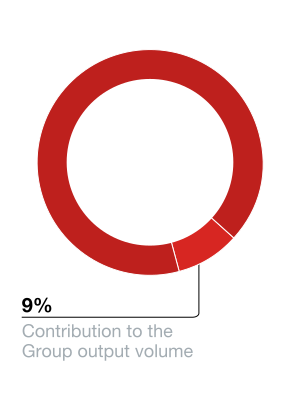
As the number two in the construction sector in Poland, STRABAG generated construction output of € 1,917.71 million in the country in 2025, accounting for 9% of total Group output (2024: 9%). Poland thus represents the third-largest market within the STRABAG Group. STRABAG’s market share of the total Polish construction market amounts to 2.2%.
Contribution to the Group output volume (%) | Overall construction volume (€ bn) | GDP growth (%) | Construction growth (%) | |||
2025 | 2025 | 2025e | 2026e | 2025e | 2026e | |
Czech Republic | 6 | 35.9 | 2.4 | 2.3 | 1.3 | 0.1 |
The Czech economy recorded GDP growth of 2.4% in 2025. In addition to a stabilised inflation rate, the gradual reduction of interest rates and a comparatively low unemployment rate within the EU, public investment and EU funding also contributed to the positive development. Strong real wage growth further stimulated private consumption. Despite announced austerity measures aimed at gradually reducing the national budget deficit, along with uncertainties surrounding government formation following the parliamentary elections in October 2025, stable GDP growth of 2.3% is expected for 2026, with growth of 2.7% and 2.8% forecast for 2027 and 2028 respectively.
The Czech construction industry recorded moderate growth of 1.3% in 2025. Key constraining factors included a shortage of skilled labour as well as persistently high prices for construction materials and energy. EU-subsidised public investment in rural development, the energy transition and the expansion of mobility infrastructure largely offset weak residential construction during the reporting year. As a result of the new government formation, Euroconstruct forecasts stagnation of 0.1% for 2026. In the following years, growth rates are expected to increase again, reaching 1.3% in 2027 and 2.9% in 2028.
Residential construction declined by 1.5% in 2025, particularly in the new-build segment, where lengthy building permit procedures dampened the anticipated positive effects of lower interest rates and stable inflation. A new digital building permit system, scheduled to enter into force from 2028, is expected to provide relief. By contrast, the renovation market, which accounts for almost one third of the residential construction market, recorded strong growth of 2.5%. Ongoing high renovation demand, together with state subsidy programmes for energy-efficient refurbishment and climate-friendly new builds, is expected to provide positive market impulses. A decline of 0.6% is forecast for 2026, before growth resumes at 2.0% in 2027.
Other building construction in the Czech Republic grew by 1.7% in 2025. Investment focused primarily on healthcare and educational facilities as well as large-scale projects by key Czech industries, while the construction of commercial buildings and offices lost importance. Increased renovation activity in the healthcare sector and the construction of high-tech facilities in semiconductor manufacturing, automotive components, electronics and energy generation are expected to support sustained market momentum. Euroconstruct forecasts growth of 2.2% in 2026 and 2.4% in 2027.
The Czech civil engineering segment recorded a strong increase of 5.2% in 2025. Public investment flowed partly into EU-funded mobility infrastructure projects, particularly in rail transport, as well as into energy, water and telecommunications networks. With fiscal policy expected to become more restrictive, public investment activity is likely to decline. At the same time, the collaboration with private companies under PPP schemes is expected to intensify. Euroconstruct forecasts slight declines of 0.2% in 2026 and 0.4% in 2027.
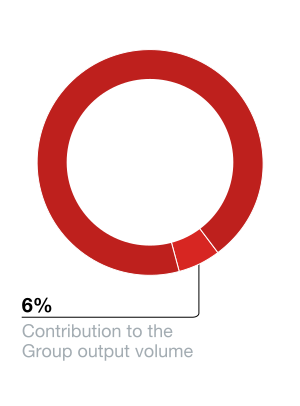
STRABAG is the number three on the market in the Czech Republic. With construction output of € 1,197.22 million, the company generated around 6% of its total Group output in the country in 2025 (2024: 5%). STRABAG’s market share of the overall construction market amounts to 3.3%.
Contribution to the Group output volume (%) | Overall construction volume (€ bn) | GDP growth (%) | Construction growth (%) | |||
2025 | 2025 | 2025e | 2026e | 2025e | 2026e | |
Hungary | 3 | 23.1 | 0.6 | 2.8 | 0.8 | 1.3 |
Hungary’s economy recorded GDP growth of 0.6% in 2025. Rising real wages, stable employment levels and a normalisation of inflation – albeit at a higher level than the EU average – had a positive effect on economic development. By contrast, the persistently high key interest rate of 6.5%, along with declining investment activity as a result of stricter budget discipline and the parliamentary elections scheduled for 2026, weighed on growth. GDP growth of 2.8% is expected for 2026, followed by 3.2% in 2027 and 2.5% in 2028.
After significant declines in the two previous years, Hungary’s construction industry recovered in 2025, recording growth of 0.8%. While residential construction saw a noticeable increase, other building construction and civil engineering developed more cautiously due to continued restrained public investment. Despite ongoing frozen EU funds – with potential changes depending on the outcome of the 2026 parliamentary elections – Euroconstruct expects a sustained recovery in construction activity. Growth of 1.3% is forecast for 2026, accelerating to 4.0% in 2027 and 4.8% in 2028.
Residential construction recorded strong growth of 11.8% in 2025. In addition to rising real wages, this positive development was driven in particular by a range of government support measures. These include a reduced fixed interest rate of 3% on mortgage loans, accelerated approval procedures, renovation grants, eased equity requirements and VAT reductions in certain regions and for the purchase of new owner-occupied homes. Euroconstruct forecasts continued high growth rates of 7.0% in 2026 and 4.0% in 2027.
Other building construction in Hungary declined by 5.1% in the reporting year. This development was due to the lack of public investment and the completion of numerous large-scale projects, particularly in the areas of electric mobility and public administrative and office buildings. Following the government’s investment freeze in 2022, a catch-up effect is expected in the healthcare and education sectors. Additional momentum could come from the defence sector and from a potential partial release of EU funds to improve the energy efficiency of non-residential buildings. Euroconstruct forecasts a decline of 4.8% for 2026, with the sector expected to return to growth of 1.1% from 2027 onwards.
In 2025, civil engineering in Hungary stagnated due to the absence of public investment and a lack of EU funding. Positive impulses are expected in the coming years, however, particularly in road, energy and water infrastructure. The state road concessionaire MKIF has launched several large-scale projects as part of its ten-year expansion initiative, while an energy programme with a volume of € 1 billion aims to expand energy and district heating networks as well as gas-fired power plants. According to Euroconstruct, this is expected to lead to significant growth in civil engineering of 4.5% in 2026 and 7.8% in 2027.
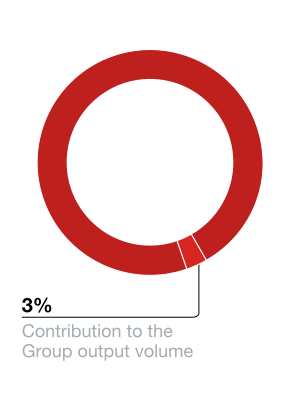
STRABAG generated construction output of € 592.41 million in Hungary in 2025, accounting for 3% of total Group output (2024: 3%). This puts STRABAG in third place in the Hungarian construction market, with a share of the overall market of 2.6%.
Contribution to the Group output volume (%) | Overall construction volume (€ bn) | GDP growth (%) | Construction growth (%) | |||
2025 | 2025 | 2025e | 2026e | 2025e | 2026e | |
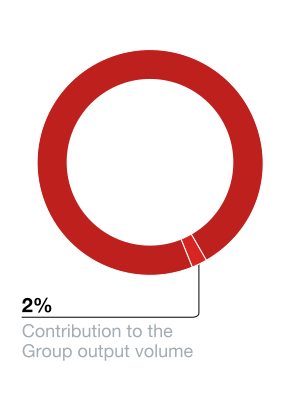
Romania | 2 | 45.9 | 0.6 | 1.2 | 0.9 | -5.5 |
Romania’s economic growth fell short of expectations, with a plus of just 0.6% in 2025. The Romanian government implemented several fiscal policy measures, including tax increases, to contain the high budget deficit and maintain the country’s existing credit rating. Inflation rates rose as a result, which, together with persistently high interest rates, weighed on private consumption. In addition, government austerity measures restricted the scope for investment. EECFA forecasts GDP growth of 1.2% for 2026 and 2.5% for 2027.
The output volume of the Romanian construction industry benefited from catch-up effects in building construction in 2025, recording growth of 0.9%. Civil engineering, by contrast, was significantly burdened by reduced public investment, high inflation, rising personnel costs due to minimum wage increases and persistently high interest rates. Against this backdrop, EECFA expects the Romanian construction industry to decline by 5.5% in 2026 and again by 2.2% in 2027. In the longer term, Romania remains a market with considerable growth potential, which is expected to gain significant momentum once fiscal constraints are eased.
Following a sharp decline of 10.9% in 2024, residential construction recovered in 2025, recording growth of 5.0%. This positive development was supported by increased lending activity and a higher number of building permits, but remained limited due to real losses in purchasing power, high inflation and elevated interest rates. The absence of wage adjustments in the public sector, together with increases in VAT and property tax, represent additional burdens for the sector. EECFA forecasts declines of 5.6% in 2026 and 3.0% in 2027.
Other building construction recorded growth of 0.6% in 2025. Positive developments were seen in the hotel, office and retail segments. In the coming years, however, commercial real estate may be affected by weak purchasing power, while education and healthcare construction is likely to be constrained by government austerity measures. EECFA forecasts a decline of 1.5% for 2026, before the sector returns to positive growth of 1.4% in 2027.
Civil engineering in Romania declined by 2.9% in the reporting year, with the energy infrastructure segment proving to be particularly stable. Despite an extensive project pipeline, reduced public investment and administrative hurdles continue to pose significant challenges. In addition, the partial loss of funding from the European Union under the NRRP is weighing on momentum, especially if delays cause projects to fall outside the funding period. Declines of 7.9% in 2026 and 3.8% in 2027 are forecast for the coming years.
With construction output of € 510.21 million in 2025, the STRABAG Group holds a market share of 1.1% of the total Romanian construction market, securing third place overall.
Contribution to the Group output volume (%) | Overall construction volume (€ bn) | GDP growth (%) | Construction growth (%) | |||
2025 | 2025 | 2025e | 2026e | 2025e | 2026e | |
Slovakia | 2 | 10.8 | 0.9 | 1.3 | 2.0 | 1.1 |
Slovakia’s economy recorded growth of 0.9% in 2025. The main dampening factors were the impact of US tariff policy on the automotive industry, inflation above the EU average and measures to consolidate the national budget, including new taxes on financial transactions and an increase in VAT. By contrast, faster-than-expected absorption of EU funding under the Recovery and Resilience Plan (RRP), together with a more dynamic recovery in private consumption, provided positive impulses. Euroconstruct forecasts GDP growth of 1.3% for 2026 and 1.5% for both 2027 and 2028.
Following a marked decline in 2024 due to the change in government, Slovakia’s construction industry grew by 2.0% in 2025. The rapid uptake of RRP funds had a positive effect, with financial resources reallocated from decarbonisation projects towards social infrastructure, benefiting other building construction in particular. Inflation and fiscal policy measures, on the other hand, including the introduction of a new levy on primary raw materials, weighed on the sector. Euroconstruct expects growth of 1.1% in 2026 and, as a result of the parliamentary elections, a decline of 0.4% in 2027.
Residential construction declined by 1.6% in 2025. Additional fees, the increase in VAT, rising costs for material, labour and construction, lengthy approval procedures and high property prices all weighed on the sector. Funding measures under the RRP aimed at improving the energy efficiency of residential buildings, declining interest rates and announced efforts to reduce bureaucracy are expected to revitalise the segment. Growth of 1.2% and 2.0% is forecast for 2026 and 2027 respectively.
Other building construction recorded strong growth of 4.5% in 2025. The main drivers were reallocations under the RRP in favour of healthcare and education infrastructure as well as social services. Investments in the commercial sector, particularly in tourism, also had a positive effect. The (electric) automotive industry continues to be regarded as a key driver of private investment. While declining interest rates and the reduction of bureaucratic hurdles offer growth opportunities, rising prices, persistent labour shortages and higher government fees and taxes remain challenges. Euroconstruct forecasts growth of 1.0% in 2026 and 2.3% in 2027.
Civil engineering recovered in 2025, recording growth of 4.9%. This was driven by several major EU co-financed road and rail projects that commenced during the reporting year following delays. For the coming years, subdued growth is expected due to strict fiscal policy, particularly in road construction. At the same time, the substantial need for refurbishment has been acknowledged, and around 600 bridges are now being considered as potential PPP projects. Energy and water infrastructure is expected to continue recording modest growth. Growth of 0.8% is forecast for 2026, before the sector is expected to decline sharply by 8.6% in 2027 as a result of the elections.
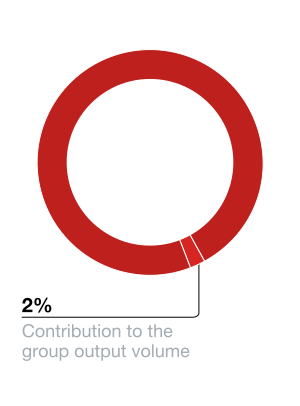
With a market share of 3.0% and construction output of € 326.93 million in 2025, STRABAG is the leader in Slovakia. In 2025, Slovakia accounted for 2% of total Group output (2024: 2%).
Contribution to the Group output volume (%) | Overall construction volume (€ bn) | GDP growth (%) | Construction growth (%) | |||
2025 | 2025 | 2025e | 2026e | 2025e | 2026e | |
Croatia | 1 | 9.0 | 3.2 | 2.9 | -0.1 | 1.3 |
The Croatian economy grew by 3.2% in 2025. A declining unemployment rate and rising real wages strengthened private consumption, while the recovery in industrial production provided additional momentum. Key drivers also included substantial EU funding as well as the lasting benefits of accession to the Schengen Area and the eurozone in 2023, which continue to reinforce Croatia’s position as an attractive investment location. Against this positive backdrop, EECFA forecasts stable GDP growth of 2.9% for 2026 and 2.5% for 2027.
Croatia’s construction industry stagnated in 2025 at -0.1%. Temporary delays in the start of major civil engineering projects were largely offset by growth in building construction. In residential construction, growth eased from a very high base level, while the project pipeline in other building construction was gradually worked through. Construction output is expected to increase by 1.3% in 2026, before stagnating again at +0.1% in 2027.
Residential construction grew by 0.6% in 2025. After eight years of strong growth, during which the market more than doubled in size, initial signs of a slowdown are emerging. Demand from foreign buyers remains high, while home ownership is becoming increasingly unaffordable for many Croatians. The government is responding with measures to create affordable housing, including subsidies, new-build programmes and restrictions on short-term rentals. EECFA forecasts growth of 2.5% for 2026, followed by 0.4% in 2027.
Other building construction recorded growth of 1.2% in 2025. Momentum came primarily from office and industrial buildings as well as education and healthcare facilities supported by EU funding. By contrast, demand in the retail and wholesale sectors as well as in hotels developed more cautiously. The existing project pipeline is being gradually worked through. Whether improved connectivity to the European transport network will translate into a stronger long-term positioning as an attractive industrial location for foreign companies remains to be seen. EECFA expects declines of 1.3% in 2026 and 0.8% in 2027.
Civil engineering declined by 2.1% in the reporting year due to delayed project starts. In the future, momentum is expected to come from EU co-financed projects in pipeline and mobility infrastructure, particularly in road and rail construction, as well as in energy and water infrastructure. The latter is set to benefit additionally from government investment of around € 1 billion in water infrastructure and flood protection. Growth of 2.0% is forecast for 2026, followed by a slight increase of 0.3% in 2027.
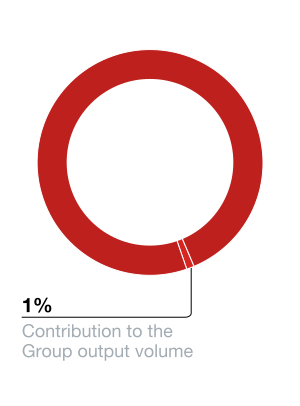
The STRABAG Group generated construction output of € 265.41 million in Croatia in 2025, achieving a market share of 2.9% and ranking first in the overall Croatian construction market.
Contribution to the Group output volume (%) | Overall construction volume (€ billion) | GDP growth (%) | Construction growth (%) | |||
2025 | 2025 | 2025e | 2026e | 2025e | 2026e | |
Australia | 3 | 196.1 | 2.1 | 2.3 | 1.6 | 2.3 |
United Kingdom | 3 | 292.8 | 1.5 | 1.2 | 1.9 | 2.8 |
Switzerland | 1 | 74.8 | 1.3 | 1.2 | 0.2 | 1.5 |
Slovenia | < 1 | 5.8 | 0.8 | 2.1 | 1.7 | 1.7 |
Italy | < 1 | 281.6 | 0.5 | 0.7 | -2.7 | 2.4 |
Sweden | < 1 | 55.5 | 0.9 | 2.6 | 3.5 | 6.2 |
Serbia | < 1 | 7.0 | 2.0 | 4.0 | -7.4 | 2.3 |
Bulgaria | < 1 | 16.0 | 3.0 | 2.7 | 2.9 | 3.1 |
Denmark | < 1 | 49.7 | 2.0 | 2.0 | 2.5 | 5.7 |
STRABAG is also active in the Americas, the Middle East, Africa and Asia, as well as in the Benelux countries and other European markets. These regions accounted for 6% of total Group output in 2025 (2024: 7%).