Equality, diversity and inclusion
STRABAG employs around 89,000 people from 159 nations representing every generation, various religions and world views, and having different genders, sexual orientations and gender identities.
Dimensions of diversity
STRABAG utilises and actively promotes diversity as a source of strength. The more diverse a team, the more diverse its perspectives and experiences. Diversity is a key advantage enabling our teams to find more innovative solutions to the construction industry’s most pressing challenges.
The promotion of equality, diversity and inclusion (EDI) ensures a safe and respectful working environment in which all employees can realise their full potential and contribute their best to the company’s success. In this respect, STRABAG focuses on three dimensions of diversity:
We focus on three dimensions of diversity
- Gender diversity
Advancement of women and increased gender diversity (male/female/non-binary) - Generation diversity
Focus on creating an environment of mutual respect across different generations and rejuvenating the age structure (counter to the societal trend) - Ethnic diversity
Focus on creating an environment of mutual respect between different ethnic groups
EDI Strategy 2030
The STRABAG Management Board adopted its first EDI strategy in 2023. The strategy defines three clear objectives, which were also communicated to employees and published on the company’s website. The goals of the EDI Strategy 2030 are:
- Annual increase of 6% in the proportion of women in management
- Gender pay gap of 0
- Mandatory leadership training on equality, diversity and inclusion
A Group-wide EDI Coordinator has been positioned within the central division BRVZ (P&C Development) with responsibility for the implementation and continuous development of the EDI strategy and objectives. An interdisciplinary EDI project team, including a member of the Management Board, meets several times a year to jointly discuss further impulses and measures and to initiate them at the Management Board level. As part of this collaboration, the EDI project team has developed objectives.
In 2025, mandatory e-learning on equality, diversity and inclusion was rolled out for all leadership employees in ten languages. In December 2025, a mandatory German-language e-learning programme was also introduced for all employees without leadership responsibility. Translation and rollout in a further 14 languages is planned for 2026.
During the reporting year, the partnership with myAbility was continued in order to promote the inclusion of people with disabilities. A key component of this collaboration is the myAbility job platform, which specifically connects people with disabilities with suitable job openings. The service, which is currently available in Germany and Austria, facilitates access to career opportunities. The partnership helps to reduce barriers and create more inclusive working conditions.
Diversity concept
Construction industry traditionally male-dominated
Construction is a traditionally male-dominated industry, making it particularly challenging for STRABAG to achieve a balanced gender ratio among its employees. This is true in all areas, from the workers on the construction site to the salaried office employees and our management levels. In 2025, women accounted for 19.8% (2024: 19.8%) of the Group’s total workforce. Group management – i.e. persons with a managerial position as defined by Section 80 of the Austrian Stock Corporation Act (AktG) – is 11.8% female (2024: 10.7%).
Share of women in the Group
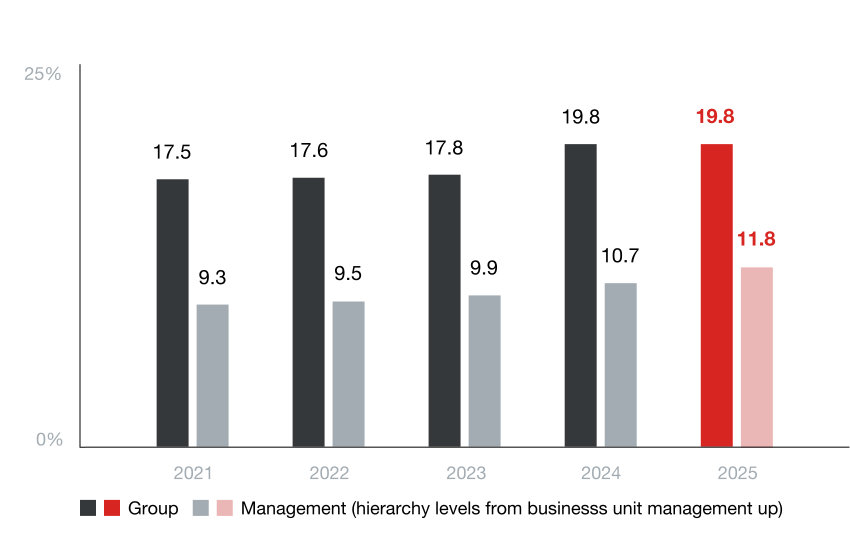
There are currently no women on the Management Board of STRABAG SE. As of 31 December 2025, the members of the Management Board were between 48 and 61 years of age and came from Germany, Austria and Hungary. Each has many years of management experience in different areas and countries of the Group.
At the end of 2025, the eleven-person STRABAG SE Supervisory Board comprised four female members: Kerstin Gelbmann, Gabriele Schallegger, Valerie Hackl and Magdolna P. Gyulainé. Women thus accounted for 36% of all Supervisory Board members at the reporting date. The members of the Supervisory Board represent three nations and were between 43 and 69 years old on the reporting date.
Several mechanisms govern appointments to the Supervisory Board:
- The registered shares no. 1 and no. 2 are each associated with the right to nominate one person to the Supervisory Board of STRABAG SE. Council Implementing Regulation (EU) 2022/581 of 8 April 2022 implementing Regulation (EU) 269/2014 of 17 March 2014 added Oleg Deripaska to the EU sanctions list. As Oleg Deripaska controlled MKAO “Rasperia Trading Limited” at the time he was sanctioned, and MKAO “Rasperia Trading Limited” itself was sanctioned by the Council of the European Union through Implementing Regulation (EU) 2024/1842 on 28 June 2024, its rights as a holder of registered share no. 2 are currently suspended.
- Five members are elected per vote by the Annual General Meeting. They are usually proposed by shareholders’ representatives to the Supervisory Board, which in turn passes a draft resolution to the Annual General Meeting.
- The employee representatives appoint to the Supervisory Board a number of employee members corresponding to the number of shareholder representatives.
- On 31 December 2025, the Supervisory Board consisted of six shareholder representatives and five employee representatives.
The Supervisory Board is responsible for appointments to the Management Board. The Supervisory Board’s Presidential and Nomination Committee makes proposals for filling vacant seats on the Management Board and deals with issues relating to successor planning. It submits a recommendation to the Supervisory Board after comparing the qualifications and experience of suitable candidates to a previously defined job description. The selection of a Management Board member is then made in the Supervisory Board.
Prerequisites for an appointment to the Management Board and Supervisory Board of STRABAG SE include the right expertise and personal qualifications as well as sufficient years of experience in leadership positions. The Management Board can best fulfil its management function and the Supervisory Board its supervisory and consulting functions with the broadest possible spectrum of skills and experience. This is achieved through diversity in terms of internationalism, educational and professional background, the representation of both genders to an appropriate degree, and the age structure.
The current nomination process has so far effectively addressed these requirements, with the result of a certain level of diversity on the boards. Through its draft resolutions to the Annual General Meeting, and through its decisions based on Presidential and Nomination Committee recommendations, the Supervisory Board helps to maintain the diversity of the Supervisory Board and the Management Board. This contribution to diversity is considered separately on a case-by-case basis. To allow a review of the implementation of the diversity criteria, short CVs of the current members of the Management Board and Supervisory Board are published in the consolidated corporate governance report.
The Supervisory Board supports the efforts being made by the Group to raise the percentage of women in the company and in management. At this time, there still seems to be no point in imposing a voluntary self-obligation for a certain percentage of women on the Management Board. Management positions within the Group are filled primarily internally, and while women currently remain underrepresented in management positions, the Supervisory Board is convinced that successful measures to promote women’s careers will result in a higher percentage of women in management in the medium term, which will end up being reflected at the higher hierarchy levels.
Measures for the advancement of women
Percentage of women to be gradually increased
One of STRABAG’s declared goals is to gradually increase the proportion of women in management from within its own ranks. By signing the UN Women’s Empowerment Principles, STRABAG emphasised this ambition already back in 2013. STRABAG is taking several steps to achieve this objective.
STRABAG endeavours to use gender-appropriate, inclusive wording and visual material that is as diverse as possible. The description of the company in job postings was revised in 2023 and emphasises the commitment to diversity. The career paths of women in the Group are regularly highlighted using testimonials to specifically address women, particularly those working in the industrial sector or graduates of technical degree programmes.
The Group’s online presence now includes a dedicated EDI landing page featuring the objectives of the EDI strategy, a clear commitment from the Management Board, success stories from within the Group and the relevant contact person. The company’s job site also reflects our focus on diverse teams.
STRABAG offers flexible working time models wherever possible to help employees reconcile their work with family life. A work-from-home guideline was established and rolled out across the Group for this purpose. We also offer part-time working arrangements and are trialling a job-sharing model. A return-to-work programme supports employees returning to their jobs following parental leave.
Our talent management programme as well as the mentoring programme focus especially on the appropriate representation of women. The EDI strategy calls for an annual increase of 6% in the percentage of women in management, in particular through internal promotion. STRABAG hopes to achieve this goal through the expansion of the Group’s internal potential management programme, among other things. The aim is for the proportion of women in this programme to correspond to the proportion of women in the respective subdivision. Key figures are collected and managed internally. STRABAG has also defined targets for the promotion of women at different hierarchical levels.
The Group Academy also offers seminars designed especially for women. Among the trade-specific training offers for all employees, those on technology and IT registered an above-average participation by women. Coaching also plays an important role, with women in management positions being able to choose between personal coaching and mentoring as well as so-called eBusiness coaching in order to explore career prospects.
In the year under report, the Group launched its Female Leaders@STRABAG initiative specifically aimed at women in management. The programme offered 32 participants the opportunity to network across the Group at two in-person events and to complete mentor training in four online sessions, enabling them to act as mentors for other women in the Group from within the talent pool.