Sustainability management
Governance
ESRS 2 GOV-1; ESRS 2 GOV-2
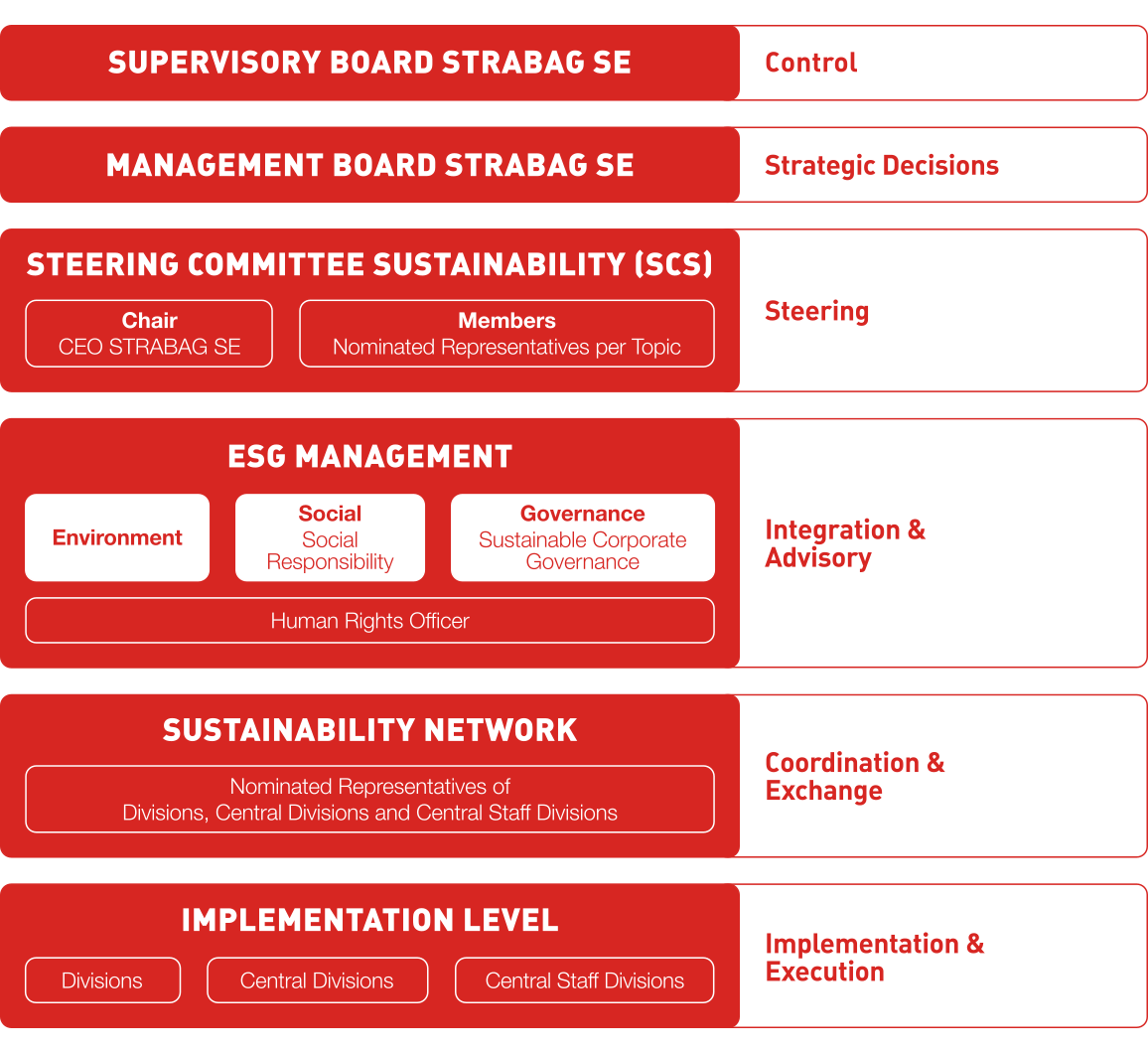
Achieving STRABAG’s sustainability targets requires a leadership and accountability structure that involves all representatives within the Group. The most important bodies and committees of STRABAG SE entrusted with the oversight and management of sustainability matters are described below. The governance structure and the associated responsibilities and supervisory duties are formally regulated in the Group-wide Sustainability Directive. The illustration below provides an overview of the relevant bodies and committees.
Governance structure
Role of the highest governance bodies
The Supervisory Board acts as the supervisory body within STRABAG SE. The Supervisory Board is kept informed of all relevant matters concerning the company’s business development, including the risk situation and risk management, and is involved in decision-making processes through regular meetings (at least four per financial year) and through ad hoc communication. The Supervisory Board may also request reports from the Management Board and inspect the company’s books, records and assets. The Chairman of the Management Board (CEO) reports to the Supervisory Board on sustainability matters – including, for example, strategic objectives and progress made – on an ad hoc basis or separately as part of an annual ESG update (since 2024). The Management Board also reports to the Supervisory Board at least once a year on measures taken to combat corruption. The Supervisory Board is likewise informed in the event of fatal workplace accidents. As the highest supervisory body, it plays a central role in overseeing and reviewing the Group’s annual sustainability reporting. The Supervisory Board has discussed the implementation of the new statutory sustainability reporting requirements together with the external auditor. In this context, the improvement proposals identified by the auditor were discussed in detail. There was no separate sustainability committee during the reporting period.
The Management Board of STRABAG SE constitutes the executive body of the Group. It is responsible for the Group’s day-to-day operations. In addition to the day-to-day business, Management Board meetings (usually held every two weeks) also address the implementation of the long-term corporate strategies. These include sustainability topics in particular, which are of central importance and are treated as a separate agenda item at every Management Board meeting. Due to the Group-wide integration of ESG management, this agenda item is introduced by various specialist departments who prepare comprehensive analyses that serve the Management Board as a basis for setting its targets. Regular reporting within the Management Board meetings, as well as in other meetings and Group conferences, ensures that the Management Board stays informed of and can monitor the progress in achieving the strategic objectives.
The inclusion of Management Board members in strategic sustainability initiatives and committees, together with ongoing reporting, ensures that the STRABAG SE Management Board receives regular and ad hoc training and information on material sustainability topics and the associated impacts, risks and opportunities, enabling it to take strategic decisions for the Group when required. The Chief Executive Officer (CEO) and the Chief Financial Officer (CFO) are informed annually about and approve the results of the materiality assessment (including impacts, risks and opportunities). This process is embedded throughout the Group through the Sustainability Directive.
In line with the international orientation and organisational structure of STRABAG SE, each member of the Management Board is responsible for one or more Group entities, either geographically and/or by business area. The heads of the divisions, central divisions and central staff divisions therefore play a particularly important role in overseeing the sustainability-related impacts, risks and opportunities affecting the entire Group by reporting regularly and directly to the Management Board.
The reporting mechanisms described above ensure that both the Management Board and the Supervisory Board are kept informed of current sustainability topics, including sustainability-related risks, enabling them to fulfil their respective functions as executive and supervisory bodies. The Management Board’s executive responsibilities include, in particular, determining the long-term corporate policy (strategic management) as well as planning, organising and monitoring the pursuit of the company’s objectives. The STRABAG Group’s Rules of Procedure regulate specific business transactions that require the approval of the Management Board. These include, among other things, strategic and operational planning as well as personnel measures such as the appointment of individuals to management positions. This ensures that the Management Board can fulfil its function as an executive and control body – including in the area of sustainability management. Within the framework of investment and financial planning, the Management Board also has the opportunity to appropriately consider sustainability topics and sustainability-related risks. In this way, the information also feeds into strategic considerations and major transactions, particularly with regard to expanding into new and market-oriented business fields. In line with Strategy 2030, acquisitions in the areas of water technology, value stream management and decarbonisation of existing buildings were approved by the Management Board and Supervisory Board during the financial year. In these business areas, both bodies see growth potential in line with the EU’s climate targets. Through the further development of ESG risk management and its integration into other control and risk systems within the Group, work is under way to establish a robust basis for balancing economic, environmental and social aspects. On this basis, the Management Board can also adopt operational measures to consistently implement our reduction pathway. During the financial year, among other things, the STRABAG SE Management Board decided to gradually operate the Group’s own construction machinery using the alternative fuel HVO 100.
Besides the internal reporting mechanisms, the Management Board’s sustainability expertise is also strengthened through active participation in external committees and exchange formats, including, for example, support of Stiftung KlimaWirtschaft.
The table below summarises the composition of the Management Board and the Supervisory Board in the 2025 financial year.
Composition of the Management Board and Supervisory Board
Name | Start of current period of office | End of current period of office | Gender | Year of birth | Nationality | ||
|---|---|---|---|---|---|---|---|
Management Board | |||||||
Number of members | 5 | ||||||
Average ratio of female to male members | 0% | ||||||
Dipl.-Ing. Stefan Kratochwill (CEO) | 19 February 20251 | 31 December 2026 | Male | 1977 | Austria | ||
Klemens Haselsteiner, BBA, BF (CEO) | 1 January 2023 | 17 January 20252 | Male | 1980 | Austria | ||
Dipl.-Ing. (FH) Péter Glöckler | 11 August 2025 | 31 December 2026 | Male | 1977 | Hungary | ||
Mag. Christian Harder | 1 January 2023 | 31 December 2026 | Male | 1968 | Austria | ||
Dipl.-Ing. (FH) Jörg Rösler | 1 January 2023 | 31 December 2026 | Male | 1964 | Germany | ||
Dipl.-Ing. Siegfried Wanker | 1 January 2023 | 31 December 2026 | Male | 1968 | Austria | ||
Dipl.-Ing. (FH) Alfred Watzl | 1 January 2023 | 6 August 20253 | Male | 1970 | Germany | ||
Supervisory Board4 | |||||||
Number of members | 11 | ||||||
Average ratio of female to male members | 36 % | ||||||
Shareholder representatives | |||||||
Mag. Kerstin Gelbmann (chairwoman) | 24 June 2022 | Until 2028 AGM5 | Female | 1974 | Austria | ||
Mag. Erwin Hameseder | 24 June 2022 | Until 2028 AGM5 | Male | 1956 | Austria | ||
Dr. Andreas Brandstetter | 24 June 2022 | Until 2028 AGM5 | Male | 1969 | Austria | ||
Dr. Valerie Hackl | 25 January 2024 | Indefinite | Female | 1982 | Austria | ||
Dipl.-Ing. Sebastian Haselsteiner | 13 June 2025 | Until 2029 AGM5 | Male | 1979 | Austria | ||
Mag. Gabriele Schallegger | 24 June 2022 | Until 2028 AGM4 | Female | 1972 | Austria | ||
Delegated by the works council | |||||||
Dipl.-Ing. Andreas Batke | 1 October 2009 | Indefinite | Male | 1962 | Germany | ||
Karl Gerdes | 1 August 2024 | Indefinite | Male | 1963 | Germany | ||
Magdolna P. Gyulainé | 1 October 2009 | Indefinite | Female | 1962 | Hungary | ||
Georg Hinterschuster | 13 October 2014 | Indefinite | Male | 1968 | Austria | ||
Daniel Riesenberg | 1 September 2025 | Indefinite | Male | 1971 | Germany | ||
1Stefan Kratochwill was appointed CEO of STRABAG SE on 19 February 2025 with immediate effect.
2Klemens Haselsteiner passed away suddenly and unexpectedly on 17 January 2025.
3Alfred Watzl resigned from his seat on the Management Board in agreement with the Supervisory Board, effective 6 August 2025 EOD.
4Five of the six members of the Supervisory Board of STRABAG SE and of its committees who have been elected by the General Meeting or delegated by the shareholders are independent pursuant to Rule 53 ÖCGK.
5Annual General Meeting
Prerequisites for election to the Management Board of STRABAG SE include the right professional qualifications, personal skills as well as many years of industry and leadership experience.
The Management Board should collectively cover a sufficiently broad range of expertise as well as educational and professional backgrounds in line with the business activities of the STRABAG Group, with the members complementing one another in terms of their knowledge and skills. Particular attention should be paid to achieving a balanced mix of technical and commercial backgrounds. This ensures that the Management Board as a whole possesses experience in the key business areas of the STRABAG Group.
Several mechanisms govern the composition of the Supervisory Board. The capital representatives are elected by the General Meeting or delegated by shareholders. The employee representatives are delegated in accordance with the Austrian Labour Constitution Act (Arbeitsverfassungsgesetz, ArbVG).
Through the active participation of Management Board members in internal working groups with an ESG focus (e.g. EDI team, Energy Transition), current developments relating to these topics are discussed at the highest management level. The extensive international management experience of both the Management Board and the Supervisory Board promotes the exchange of perspectives and supports the implementation of Group-wide strategic decisions. Specific expertise in the area of sustainability and the associated impacts, risks and opportunities is also contributed by experts in the various organisational entities. In addition, the Management Board and the Supervisory Board can draw on external experts where required.
The Steering Committee Sustainability (SCS) manages the Group-wide sustainability efforts and simultaneously monitors the achievement of the strategic sustainability goals. The composition and membership of the SCS are determined on the basis of the business areas and largely reflect our value chain. Membership of the SCS is associated with responsibility for specific trades and thematic areas.
Tasks of the Steering Committee Sustainability:
- approval of position papers, policies and guidelines on sustainability
- monitoring of the strategy’s implementation and of the defined roadmaps to achieve the objectives
- preparation of decision-making criteria for the STRABAG SE Management Board
- formulation and further development of minimum sustainability standards
SCS decisions are taken several times per year and on an ad hoc basis by way of circular resolutions. At least one in-person meeting is held each year.
The ESG management is structured according to the topics of environment, social responsibility and sustainable corporate governance. Owing to their broad scope, these topics are addressed and managed by different central organisational entities within the Group. These units are responsible for operationalisation by providing the framework and tools needed to translate requirements, strategies and measures from management decisions into implementation. These central organisational entities also provide their expertise to the STRABAG SE Management Board, the Steering Committee Sustainability, and to the divisions, central divisions and central staff divisions, and act in an advisory capacity in implementing the sustainability strategy and the associated requirements and measures. The organisational unit “Sustainability – Governance, Reporting & Data” supports the establishment of the governance structure for sustainability and is also responsible for organising and coordinating development and updates of the sustainability strategy as well as for Group-wide sustainability reporting.
The role of the Human Rights Officer is another central function within ESG management. The Human Rights Officer is responsible for monitoring the human rights risks management system and the complaints procedure, as well as for reviewing their effectiveness, and acts in an advisory capacity to the Management Board of STRABAG SE and to the heads of the divisions and central divisions responsible for fulfilling human rights due diligence obligations. The Human Rights Officer acts independently and is not bound by instructions.
The corporate sustainability network includes one nominated representative from each division, central division and central staff division. The purpose of the network is to facilitate the exchange of experience and knowledge within the Group and to share information on best practice examples. The representatives are tasked with conveying information from the sustainability bodies (SCS, ESG management) to their respective division and of reporting to their management as well as communicating information about their own sustainability-related activities, actions and projects back to the network. The representatives also provide their specific expertise for Group-wide projects and in response to relevant enquiries. The sustainability network meets four times a year.
At the division, central division and central staff division level, the minimum sustainability standards and the associated measures are implemented and applied in compliance with legal requirements. Working together with ESG management, these entities are responsible for developing and implementing the respective roadmaps.
ESRS 2 GOV-3
Group-wide sustainability-related performance criteria for inclusion in remuneration systems are currently under evaluation. In particular, defining, measuring and managing appropriate target values (key performance indicators) remains challenging. As a result, sustainability criteria are currently not used in determining the remuneration of members of the Management Board or Supervisory Board.
ESRS 2 GOV-4
Due diligence encompasses the processes and procedures implemented by STRABAG that aim to identify and adequately manage actual or potential adverse impacts on people or the environment. The core elements of due diligence are reflected in the sustainability statement.
Core elements of due diligence | Reference in the sustainability statement |
Embedding due diligence in governance, strategy and business model | |
Engaging with affected stakeholders in all key steps of the due diligence | Our social responsibility; Own workforce; Workers in the value chain; Affected communities |
Identifying and assessing adverse impacts | |
Taking actions to address those adverse impacts | |
Tracking the effectiveness of these efforts and communicating |
ESRS 2 GOV-5
STRABAG has established various control mechanisms to ensure transparent and compliant reporting. However, these are not embedded in a dedicated risk management process specifically for sustainability reporting.
ESG-related risk management processes are described and regulated through overarching Group requirements, including the Management Manual of STRABAG SE with its associated policies and in the Group Sustainability Directive adopted in 2025. The Sustainability Directive defines the responsibilities and accountabilities for the provision of sustainability data and information.
To implement the CSRD reporting obligations, a steering group has been established, comprising representatives of the ESG management team and BRVZ, that meets several times per year. Based on the ESRS requirements and existing data processes, this steering group aims to further develop sustainability reporting at STRABAG. Control mechanisms such as the interim preparation of key figures ensure that the collected data are validated and that relevant processes are further developed as required.
In line with the Group-wide data strategy and the associated transition towards a data-driven organisation, increasing standardisation and automation of data collection and processing are being pursued. The measures already implemented for this purpose have a long-term impact, meaning that significant progress can be expected in the coming years. Plans also include strengthening data governance, which will provide for enhanced quality controls of collected data at different hierarchical levels in order to make them available for analysis and management purposes. These and further measures are intended to prevent potential risks associated with sustainability reporting.
As the collection and processing of sustainability data affect the entire Group, approval must generally be obtained from the Management Board of STRABAG SE or from the relevant management units. Information is therefore communicated on an ad hoc basis.
Value chain and strategy
ESRS 2 SBM-1
The construction industry – and therefore STRABAG as well – faces major challenges. Mitigating climate change requires a significant reduction in greenhouse gas emissions, particularly in climate-intensive industrial sectors such as construction. To meet the demand for housing and infrastructure, existing buildings must be refurbished and new structures built to sustainable standards. Innovative construction methods are therefore needed to align these activities with new and future requirements regarding energy efficiency, land use and resource consumption. This obliges STRABAG to act with foresight, but it also underscores the fact that the construction sector is a key industry in achieving sustainability targets.
Services along the entire construction value chain
STRABAG operates predominantly in Europe and – particularly in its core markets in Central and Eastern Europe – provides services along the entire construction value chain. Our company’s activities are correspondingly diverse. Outside Europe, STRABAG focuses primarily on the English-speaking world and on long-standing established markets in South America and the Middle East. In 2025, the acquisition of Georgiou Group also opened up Australia as a market with regionally distributed operations.
The diversity of our value chain is matched by the capabilities and expertise of our 88,556 employees who deliver our services. Partnership, trust and reliability are central values that guide our interactions with stakeholders.
STRABAG’s activities cover all areas of the construction industry and span the entire construction value chain. The Group’s core products are structures of all kinds, which form the focus of the company’s activities and account for 85% of Group output. These include both building construction projects and infrastructure schemes in the areas of transport routes, bridges, tunnels, rail infrastructure, public transport as well as energy and water infrastructure. With just under 70%, a substantial share of these construction services is carried out under public-sector contracts and serves the general public. In addition, STRABAG operates a dense network for the production of building materials and provides services in the fields of planning, project development as well as the structural refurbishment and decarbonisation of buildings and their operation. As of 1 January 2025, STRABAG bundles its expertise in energy and water infrastructure within the new corporate division Energy Infrastructure.
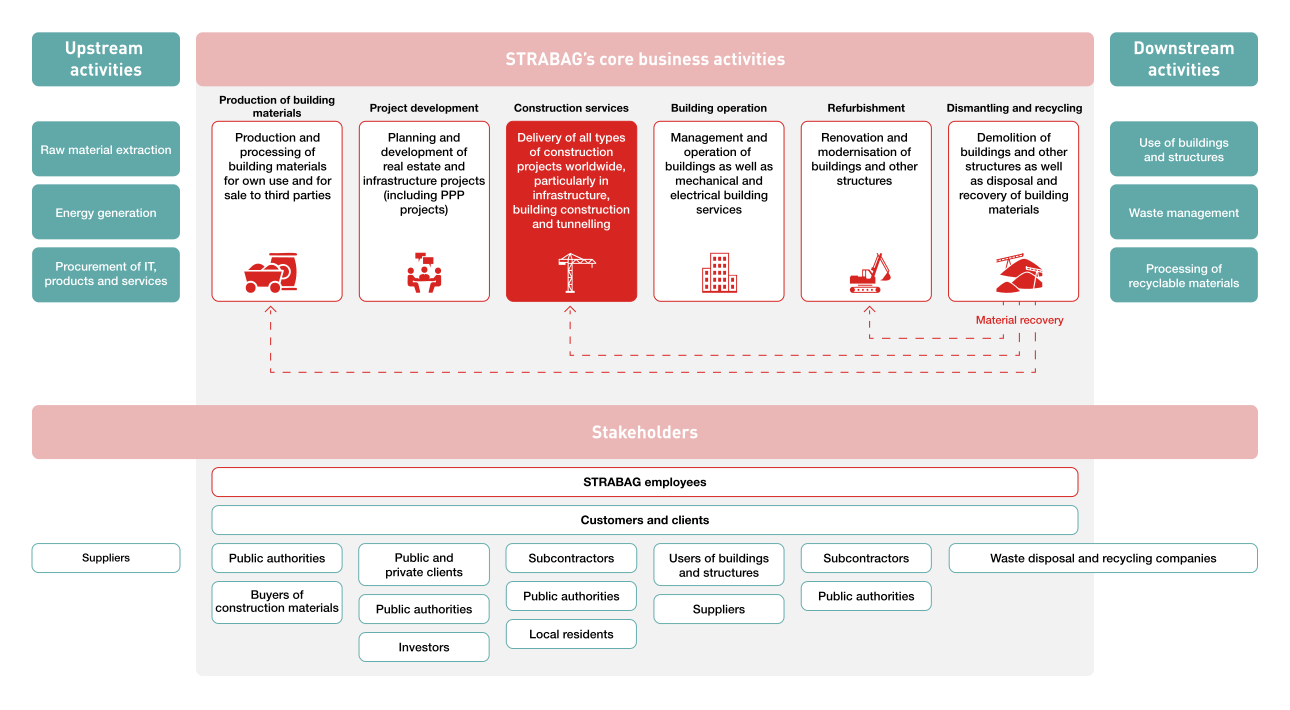
As a result of these diverse business areas, several value chains exist within the Group. For the purposes of focused presentation, the emphasis here is placed on the core business of providing construction services. The following descriptions are therefore structured according to the life cycle phases of structures and cover the key activities and principal partners along this process.
Presentation of the STRABAG SE value chain for disclosure requirements in connection with ESRS 2 SBM-1
Production of building materials
STRABAG operates a dense network of its own production facilities to ensure the supply of building materials from in-house resources. The most important building materials include asphalt, concrete, cement, stone and gravel, which are used both for the company’s own needs and are offered for sale to third parties. In the case of asphalt in particular, a particularly high self-sufficiency rate of 86% is achieved. The other building materials and raw materials used are largely sourced from regional suppliers to keep transport costs economically viable. Strategic objectives to expand our capabilities in the procurement and handling of construction materials as well as in dismantling and recycling aim to increase resource efficiency. This not only reduces our dependence on third parties but also helps to limit human rights risks and compliance risks that can arise from complex global supply chains. Our production facilities also represent an important lever for the decarbonisation of the Group, for example by converting asphalt mixing plants to renewable energy sources. In addition to mineral-based building materials, STRABAG also uses renewable raw materials, including those based on wood, straw or hemp – albeit to a comparatively limited extent. With the acquisition of Naporo Klima Dämmstoff GmbH in the 2024 financial year, STRABAG expanded its product portfolio in the area of sustainable building materials and is pursuing the strategic objective of further expanding the production of renewable raw materials.
Project development
Considering the entire life cycle of structures during the planning and design phase is crucial for forward-looking construction shaped by trends such as increasing urbanisation and the climate crisis. Concrete policy objectives, such as those set out in the European Green Deal, call for the low-emission construction and operation of structures as well as an increase in renovation rates. Despite these objectives, however, sustainability criteria such as those outlined in the EU Taxonomy are generally not yet taken into account in tender procedures. Partnership-based collaboration with clients is therefore regarded as an important means of designing and planning structures in line with new requirements. With TEAMCONCEPT, STRABAG pursues a partnering model in which the client and contractor form a team already during the planning phase. STRABAG also offers additional planning-related consulting services (e.g. sustainability potential analysis) that specifically address sustainability requirements for structures and involve clients in the planning and development of projects at an early stage. An additional benefit for clients and partners arises from the broad implementation of ISO 9001 certification within the STRABAG Group. The certification represents a structured and transparent quality management system. It builds confidence in the quality of our services and supports efficient collaboration. In 2025, measured by revenue, around 99.6% of the permanent regional business was ISO 9001 certified.
STRABAG’s service portfolio also includes the development of real estate, infrastructure and renewable energy projects. The Group develops, builds, sells and leases real estate projects with a focus on building developments that are constructed in a resource-efficient manner and operated with high energy efficiency. In addition, STRABAG has a successful track record spanning more than three decades in the field of concession models, with a portfolio of 44 public-private partnership (PPP) projects in the areas of mobility, energy and water infrastructure as well as social infrastructure (building construction).
Construction services
Construction forms the core of STRABAG’s business model, with the transportation infrastructure and building construction segments accounting for nearly 70% of our output in 2025. In building construction, more than in transportation infrastructures, STRABAG also outsources some of its work to subcontractors, enabling capacities to be adapted more flexibly to the current market environment. Through these two business areas, STRABAG contributes to municipalities and other public clients primarily through the expansion of infrastructure – particularly in the area of mobility – and housing. Through its service offering for infrastructure maintenance, STRABAG also secures long-term contracts and recurring revenues. Employees as well as investors benefit from the Group’s economic stability. Employees gain the security of stable jobs and incomes, while investors can expect continuous returns, reduced risk and sustainable value growth of their investments. The transformation of our construction processes represents a key lever for achieving our sustainability targets. A large share of STRABAG’s emissions is energy-related, which is why the operation of construction machinery constitutes a central action area in our transition plan.
Services for decarbonising the construction industry
Building operation
In 2022, the operation of buildings accounted for around 26% of global energy-related greenhouse gas emissions (IEA, 2023). In addition to traditional facility management, STRABAG is expanding its service offering in the field of mechanical and electrical engineering services (M&E), with a particular focus on implementing and providing sustainable energy management solutions across a wide range of property types – including the company’s own real estate, existing properties and new builds, and highly complex facilities such as those in the healthcare sector – thereby contributing to the decarbonisation of existing buildings.
Refurbishment
The construction and operation of buildings involves a high level of resource consumption. In addition to energy use, the material intensity of the construction sector is of considerable environmental relevance. Among other factors, the demolition, dismantling and deconstruction of buildings – which generate large quantities of construction waste and hard-to-recycle materials – as well as the low rates of reuse and recycling for many building materials, contribute to make the construction sector one of the most waste-intensive industries (European Commission, n.d.). The action area of Reconstruction, Conversion & Refurbishment brings together the activities required to use existing buildings sustainably while conserving both energy and material resources: deconstruction, maintenance, renovation and modernisation.
Dismantling and recycling
To close the loop towards a circular economy, STRABAG also offers services related to demolition and dismantling, including the recycling of building materials. The aim is to conserve resources, upgrade materials to a high quality and avoid landfill disposal.
Contribution to sustainability targets
STRABAG offers a broad range of services that are aligned with global sustainability objectives. Through the construction, expansion and modernisation of infrastructure, STRABAG makes a significant contribution to the development of cities and regions. This includes in particular construction services in the areas of rail and energy infrastructure, the construction of energy-efficient buildings as well as projects aimed at adapting to the impacts of climate change. At the same time, current construction methods and practices present challenges, as construction projects are generally associated with high emissions, land use and interventions in ecosystems. In particular, the use of energy-intensive materials such as concrete and asphalt as well as the use of fossil-fuel-powered construction machinery remains in tension with climate targets, even though progress is being made in recycling, alternative building materials and low-emission powertrain technologies. Digital planning methods such as Building Information Modelling (BIM) also enable more precise use of resources.
To evaluate our sustainability performance, STRABAG carried out an SDG Impact Assessment in the 2025 financial year. The aim was to analyse our business activities with regard to the UN Sustainable Development Goals. The results of the assessment are presented in the ESG Data Factsheet.
To minimise negative impacts, STRABAG has defined a set of strategic sustainability targets and is continuously working on the sustainable transformation of the company. This includes the further development of products and services – such as the use of sustainable building materials and construction methods – as well as measures to uphold our social responsibility towards our own employees, those within the supply chain and local communities.
Expanding our sustainability strategy
To strategically anchor the considerable opportunity potential of our value chain, STRABAG adopted its first sustainability strategy in 2021 with a clear commitment to decarbonising the value chain by 2040. This strategy was expanded in 2024 to include additional topics relating to environmental, social and governance aspects.
In recent years, the topic of sustainability has become increasingly prominent across all areas of life and the economy. This can be seen in more stringent legal requirements, changing expectations among our stakeholders, and the growing body of scientific evidence relating to climate change, biodiversity loss and other global challenges. These developments call for a new approach, which at STRABAG is reflected in an updated sustainability strategy that was adopted by the STRABAG SE Management Board in the first quarter of 2025 and is applicable across the entire Group.
The expanded sustainability strategy comprises several focus topics assigned to the areas of environment, social responsibility and sustainable corporate governance. Through its activities as a construction group, STRABAG has potential impacts within these focus topics that must be carefully considered – because STRABAG can influence them both positively and negatively, and because they involve both risks and opportunities.
STRABAG has defined various action clusters for these focus topics, with specific KPIs established for some of these actions. Progress in implementing the actions is presented in the respective thematic chapters.
Our sustainability strategy
Environmental
- Decarbonisation: With a science-based reduction pathway, we are lowering greenhouse gas emissions across our entire value chain. By 2030, we aim to reduce our Scope 1 and Scope 2 emissions by 42% and our Scope 3 emissions by 25%, with the goal of becoming climate neutral by 2040.
- Circular economy: We are putting circular economy principles into practice by reducing the consumption of primary raw materials, minimising waste and preserving resources at a high level of quality.
- Biodiversity: By establishing a biodiversity management system, we minimise our negative impacts on the local flora, fauna and funga while contributing to the preservation of intact ecosystems.
Social
- Our employees: Protecting and promoting the health of all our employees, fostering a strong learning culture and creating an inclusive work environment are key action areas for us to maintain our position as an attractive employer.
- Human rights along the value chain: The value chain in the construction industry is complex – our social responsibility and due diligence obligations therefore extend not only to our own employees but also to a wide range of other stakeholders, particularly suppliers and their employees.
- Added value for society: By strengthening the positive dialogue with local communities, we can shape our impact responsibly for all.
Governance
- Fair competition: In order to live up to our commitment to being a reliable business partner, contractor and employer, STRABAG promotes compliant behaviour and ethical conduct as well as a corporate culture based on partnership and trust.
- Sustainable corporate governance: To ensure sustainable corporate governance, we rely on clear structures, processes and responsibilities. This enables us to safeguard integrity in our business conduct and to identify impacts, risks and opportunities at an early stage.
Stakeholder engagement
ESRS 2 SBM-2
Stakeholders have various opportunities to contribute their interests and views as a way of providing impulses for STRABAG’s strategy and business model. The wide range of options for engagement allows individual and targeted forms of collaboration to be shaped flexibly depending on the context and specific needs. Any adjustments to strategic objectives and business models are therefore also based on changing stakeholder expectations. Such changes include, for example, actions to expand the service portfolio to include sustainable construction services and to strengthen decarbonisation initiatives. Plans also include increased investment in low-emission technologies and the expansion of partnerships to promote sustainable value chains (chapter “Climate change”).
Stakeholder group | Key engagement and dialogue formats | Frequency | Main purpose of the engagement and dialogue format |
|---|---|---|---|
Own employees | Employee appraisal interview | Annually | Exchange on performance, strengths and opportunities to improve collaboration, as well as promotion of professional development. |
Onboarding and offboarding discussions | Event-driven | Further development of processes and due diligence obligations in connection with personnel and organisational development. | |
Investigation of workplace accidents | Event-driven | Further development of processes and due diligence obligations in connection with occupational safety. | |
Participatory innovation management (e.g. intrapreneurship programme adASTRA, ideas management) | Continuous exchange | Submission of ideas and improvement proposals that contribute to STRABAG’s strategic action areas, including the development of new business models. | |
Customers and clients | Standardised customer satisfaction surveys | After project completion1 | Obtaining feedback on project execution and deriving improvement measures. |
Joint planning of construction projects (e.g. within partnering models such as TEAMCONCEPT) | Continuous exchange | Early alignment of requirements and expectations as well as consistent alignment of construction projects towards sustainability. | |
Suppliers | Audits | Continuous exchange2 | Prevention of human rights and environmental risks and strengthening of supplier relationships. |
Negotiation meetings | Continuous exchange | Further development and management of supplier relationships through regular coordination on performance, terms and areas for improvement; ensuring supply capability and quality throughout the contract term. | |
Investors | Annual General Meeting | Annually | Provision of information on the company’s position as well as dialogue and voting by shareholders on key corporate decisions. |
Investor meetings, conferences and roadshows | Continuous exchange | Provision of information and promotion of dialogue on a wide range of company-related topics. | |
Capital Market Day | Event-driven | Provision of information on strategic developments or progress. | |
Affected communities and local residents | Community management | Continuous exchange | Exchange regarding concerns raised by local residents; provision of transparent information on construction projects. |
NGOs | Stakeholder dialogues and expert discussions | Continuous thematic exchange | Obtaining external perspectives on sustainability topics; exchange of information on current developments; understanding societal expectations. |
Universities and research institutions | Research collaborations | Continuous project-related exchange | Joint development and validation of solutions. |
Peers | Committees and industry events | Continuous exchange | Exchange on current industry developments in order to take them into account in strategic considerations. |
1For projects with a contract value of > € 500,000
2Suppliers are selected on a risk-based basis
The structured engagement formats for our own employees include the appraisal interviews that are held annually in accordance with the respective Group directive, as well as the exit interviews conducted when an employee leaves the company. These conversations provide valuable insights that inform the continued refinement of our human resource development processes. When investigating workplace accidents, the parties involved in the incident are also included where appropriate and possible in order to conduct a structured analysis of the events.
Our employees can raise their concerns and issues at any time through channels such as the whistleblower platform or the ombuds system. Potential remedies, along with the regular review of their effectiveness, provide valuable input for assessing our processes. STRABAG also relies on participatory formats, including the adASTRA intrapreneurship programme and a structured ideas management. adASTRA has already led to the establishment of new companies that contribute to STRABAG’s strategic action areas.
In addition to engaging with our internal stakeholders, we also seek the dialogue with other relevant stakeholders outside the Group. These include, in particular, our customers, investors and suppliers. We also maintain contact with universities, research institutions, the media, political institutions and NGOs as spokespeople for “silent” stakeholders such as nature. To foster exchange between STRABAG and these stakeholder groups, we use a variety of engagement formats, including participation in trade fairs and industry events, stakeholder dialogues and the establishment of research collaborations. When updating our Group strategy, we engage with analysts and investors through dedicated events, as was the case in 2023 with the Strategic Update 2030.
Customer satisfaction survey
Clients are among STRABAG’s key stakeholders. In order to secure new contracts on a regular basis and improve internal processes, customer satisfaction is measured according to a standardised Group-wide approach. To assess customer satisfaction, contracting authorities in all Group countries are invited to provide project-related feedback through an online survey (for projects with a contract value of > € 500,000) on the following aspects:
- Organisational efficiency and technical realisation
- Responsible and sustainable handling of people and resources
- Professional competence as well as communication and cooperation within and with our team
The corresponding process is embedded in the Group-wide minimum standards for the procurement and execution of construction projects (Common Project Standards). The management system officers coordinate the standardised measurement methodology and reporting at Group level. At country level, implementation is monitored by the designated officers as part of internal audits. Additional procedures for measuring customer satisfaction may be implemented by the operational entities.
Customer satisfaction results
In 2025, customer satisfaction was surveyed across 1,500 construction projects (2024: 1,893). The response rate was 40%, unchanged from the previous year (2024: 40%). The results are shown in the table below.
Aspects | 2025 | 2024 |
Organisational efficiency and technical realisation | 4.45 | 4.39 |
Responsible and sustainable handling of people and resources | 4.43 | 4.41 |
Team: professional competence as well as communication and cooperation | 4.67 | 4.61 |
Total | 4.52 | 4.46 |
Through active participation in various committees with peers – for example the Federation of the German Construction Industry (Hauptverband der Deutschen Bauindustrie) as well as sustainability-oriented initiatives such as the Stiftung KlimaWirtschaft – STRABAG gains insights into current industry developments and incorporates them into its strategic considerations. An internal working group coordinates the flow of information on the positions represented and forwards it in a structured manner to the Steering Committee Sustainability, which is chaired by the CEO.
Stakeholder dialogue
STRABAG not only participates in but also actively organises exchange formats with external stakeholders. Most recently, in September 2024, the company organised a stakeholder dialogue on the topic of “Ecological and social supply chain” was organised. Participants included representatives of the STRABAG Group as well as external stakeholders such as suppliers, partner companies, clients and academia. This group covered a significant part of the construction value chain, which is affected to varying degrees by new regulatory requirements and challenges along the supply chain. In various interactive dialogue settings, the availability of data was identified as a key lever for fulfilling due diligence obligations and addressing these challenges. Building on the insights gained and an expanded network, a further stakeholder dialogue on the topic “Sustainable transformation” is planned for 2026.
Specific stakeholder dialogues on human rights topics are conducted as part of the roll-out of our Social Compliance Management System and the associated risk analyses as well as during the development of specific actions. Further information can be found in the chapter Workers in the value chain.
At the level of our construction projects, affected communities and local residents represent another key stakeholder group. Dialogue with these stakeholder groups is often required by law. A key initiative to strengthen the dialogue with these stakeholders is the planned implementation of a Group-wide guideline for engaging local communities and residents at project level. In 2025, the existing concept was further refined in order to facilitate practical application of the guideline for the operational units of the STRABAG Group.
Sources – Sustainability Management
European Commission. (n.d.). Construction and demolition waste. Retrieved 18 February 2026
International Energy Agency. (2023). Buildings. Retrieved 18 February 2026.