Segment report
Overview of the four segments within the group
In 2025, the business of STRABAG SE was divided into four segments: the three operating segments North + West, South + East and International + Special Divisions, as well as the segment Other, which comprises the Group’s central divisions and central staff divisions. In 2025 and to date in 2026, the segments were composed as follows:
Management Board responsibility: Jörg Rösler
Germany, Switzerland, Scandinavia, Benelux (since 17 January 2025), Ground Engineering
Management Board responsibility: Klemens Haselsteiner
Benelux (until 17 January 2025)
Management Board responsibility: Péter Glöckler (since 11 August 2025), Alfred Watzl (until 6 August 2025)
Austria, Poland, Czech Republic, Slovakia, Hungary, Romania, South-East Europe, Construction Materials
Management Board responsibility: Siegfried Wanker
Tunnelling, International, United Kingdom, Australia, Infrastructure Development, Real Estate Development, Energy Infrastructure, Building Solutions, Hold Estate
Management Board responsibility: Klemens Haselsteiner (until 17 January 2025), Stefan Kratochwill (since 19 February 2025) and Christian Harder
Central Divisions, Central Staff Divisions
Klemens Haselsteiner passed away on 17 January 2025. The remaining members of the Management Board assumed his responsibilities on an interim basis until Stefan Kratochwill was appointed CEO of STRABAG SE with immediate effect on 19 February 2025.
Construction projects are assigned to one of the segments (see chart below). Projects may, of course, be assigned to more than one segment. This is the case, for example, with PPP projects, where the construction component is reported in the respective geographical segment, while the concession component is shown in the concessions unit of the segment International + Special Divisions. In projects spanning more than one segment, commercial and technical responsibility generally lies with the segment that has the higher share of the overall project value.
Segments are primarily categorised according to geographical aspects. Specialist activities in particular – such as tunnelling – are naturally in demand worldwide and are therefore shown in the segment International + Special Divisions. At the same time, cross-border business fields such as ground engineering or construction materials are also found in the segments North + West and South + East. These are predominantly organised from a country within the respective geographical segment.
Certain services may be provided in more than one segment. In the following, activities are assigned to the segment which the most significant portion of the services was provided. Details can be found in the table.
With only a few exceptions, STRABAG offers services across all areas of the construction industry in the individual European markets in which it operates, covering the entire construction value chain.
Range of services offered
North + West | South + East | International + Special Divisions | |
Residential Construction | √ | √ | √ |
Commercial and Industrial Facilities | √ | √ | √ |
Public Buildings | √ | √ | √ |
Engineering Ground Works | √ | √ | √ |
Bridge Construction | √ | √ | √ |
Power Plants | √ | √ | √ |
Roads, Earthworks | √ | √ | √ |
Protective Structures | √ | √ | √ |
Sewerage Systems | √ | √ | √ |
Production of Construction Materials | √ | √ | √ |
Railway Construction | √ | √ | |
Waterway Construction, Embankments | √ | √ | |
Landscape Architecture and Development, Paving, Large-Area Works | √ | √ | |
Sports and Recreation Facilities | √ | √ | |
Ground Engineering | √ | ||
Environmental Technology | √ | √ | |
Production of Prefabricated Elements | √ | √ | |
Tunnelling | √ | ||
Real Estate Development | √ | ||
Infrastructure Development | √ | ||
Renewable Energy Development | √ | ||
Operation/Maintenance/Marketing of PPP and Renewable Energy Projects | √ | ||
Building Solutions | √ |
Segment North + West
The North + West segment delivers construction services of nearly any kind and size with a focus on Germany, Switzerland, the Benelux countries and Scandinavia. Ground engineering can also be found in this segment.
€ mn | 2025 | 2024 | Δ 2024-2025 % | Δ 2024-2025 absolute |
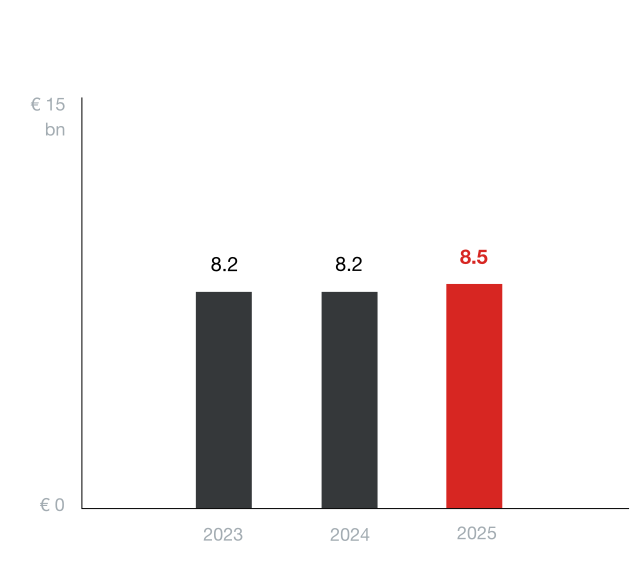
Output volume | 8,531.01 | 8,239.86 | 4 | 291 |
Revenue | 7,511.87 | 7,221.27 | 4 | 291 |
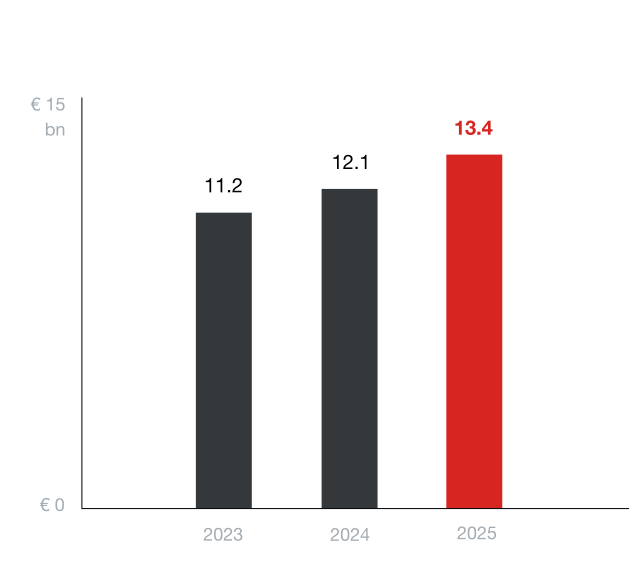
Order backlog | 13,413.69 | 12,088.14 | 11 | 1,326 |
EBIT | 840.96 | 692.67 | 21 | 148 |
EBIT margin (% of revenue) | 11.2 | 9.6 | ||
Employees (FTE) | 23,161 | 22,392 | 3 | 769 |
Output volume – North + West segment
€ mn | 2025 | 2024 | Δ 2024-2025 % | Δ 2024-2025 absolute |
Germany | 7,889 | 7,655 | 3 | 234 |
Switzerland | 228 | 223 | 2 | 5 |
Benelux | 181 | 139 | 30 | 42 |
Sweden | 117 | 117 | 0 | 0 |
Austria | 45 | 35 | 29 | 10 |
Romania | 42 | 31 | 35 | 11 |
Denmark | 7 | 19 | -63 | -12 |
United Kingdom | 5 | 13 | -62 | -8 |
Other countries | 17 | 8 | > 100 | 9 |
Total | 8,531 | 8,240 | 4 | 291 |
Output, revenue and EBIT
Greatest momentum in Germany
Output in the segment North + West increased by 4% in the 2025 financial year to € 8,531.01 million. Given its relative size within the segment, Germany made the strongest contribution to this development. Growth here was driven by projects in infrastructure and industrial construction, while municipal road construction declined due to the delayed adoption of the federal budget in the wake of the federal elections. Gains were also recorded in the Benelux countries, primarily in building construction.
Revenue rose in line with output by 4% to € 7,511.87 million. EBIT increased significantly by 21% to € 840.96 million, corresponding to an EBIT margin of 11.2%, which was thus further expanded from an already very high level. This development was driven primarily by two factors in Germany: positive contributions from large-scale infrastructure projects and mild weather conditions, which led to higher capacity utilisation towards the end of the year.
Output volume
Order backlog
Order backlog
Order backlog expanded at high level
The order backlog as at 31 December 2025 increased by 11% to € 13,413.69 million. The primary driver behind this development was the home market of Germany, with strategically important projects in mobility and energy infrastructure, including key construction sections of the Fehmarn Sound Crossing and contracts in power transmission line construction. In the area of high-tech facilities, the backlog was strengthened by a semiconductor megaproject and by the first construction phase of the IPAI campus for artificial intelligence. Other markets in the segment also contributed positively to the development of the order backlog, albeit to a lesser extent.
Employees
The number of employees grew by 3% to 23,161 FTEs. The strongest increase was recorded in Germany, in line with output development. Moderate increases were also seen in the Benelux countries and Switzerland.
Outlook
Significant output growth expected
Based on the further rise in order backlog, STRABAG expects significant growth of its output volume in the North + West segment in 2026 despite partly challenging conditions.
In Germany, the construction industry is showing signs of recovery across all areas for the first time in five years. Key drivers include the announced investments by Deutsche Bahn and the € 11 billion federal roads budget for 2026. Growing demand linked to the energy transition is providing additional impetus. At the same time, limited municipal budgets and the ongoing intense price competition remain notable challenges. Should planning and approval procedures be accelerated – including through alternative contract models – the € 500 billion off-budget infrastructure fund made available by the Federal Government could lead to a perceptible increase in demand, at the earliest towards the end of 2026. In residential construction, following the sharp declines of previous years, initial signs of a turnaround are emerging, supported by stabilising construction costs and improved financing conditions. While private households and property developers continue to act cautiously, increasing investment is expected in the context of the off-budget fund for infrastructure and climate neutrality.
In the Benelux countries, there is still strong competitive pressure. STRABAG is responding to this environment by maintaining a highly selective approach to tendering. In the Netherlands and Belgium, the company is seizing initial opportunities in industrial construction, particularly in projects relating to the energy transition. Demand in the residential construction market has also increased slightly.
In Scandinavia, the consolidation and stabilisation measures already initiated are being continued. Significant growth is expected in both the Danish and Swedish construction markets in 2026. STRABAG’s focus is on medium-sized projects, primarily in commercial and industrial construction.
In Switzerland, demand for construction services remains stable. The necessary investments have been implemented to continue on the growth path that has been embarked upon.
Selected projects – North + West segment
Country | Project | Order backlog in € mn | As % of total Group order backlog |
Germany | Bayerische Versorgungskammer | 419 | 1.3 |
Germany | US hospital, Weilerbach | 411 | 1.3 |
Germany | Lock Kriegenbrunn | 316 | 1.0 |
Germany | U5 East, Hamburg | 302 | 1.0 |
Germany | Central Business Tower | 297 | 1.0 |
Segment South + East
The geographic focus of the segment South + East is on Austria, Poland, the Czech Republic, Slovakia, Hungary, Romania and South-East Europe. The construction materials activities are also handled within this segment.
€ mn | 2025 | 2024 | Δ 2024-2025 % | Δ 2024-2025 absolute |
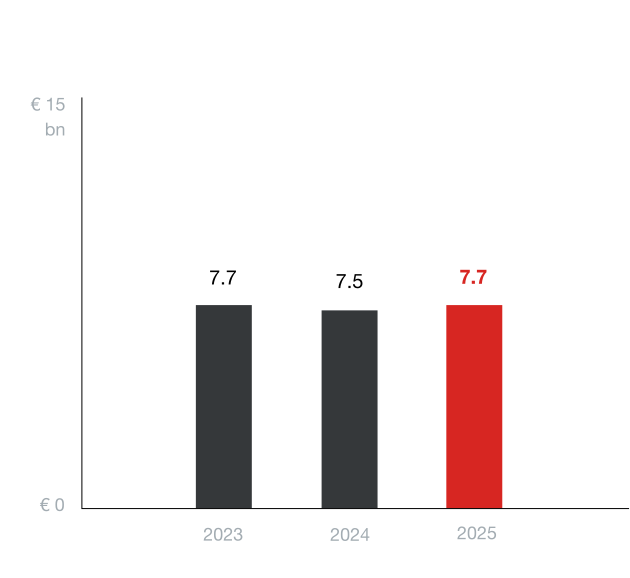
Output volume | 7,694.14 | 7,502.30 | 3 | 192 |
Revenue | 7,238.46 | 7,123.76 | 2 | 115 |
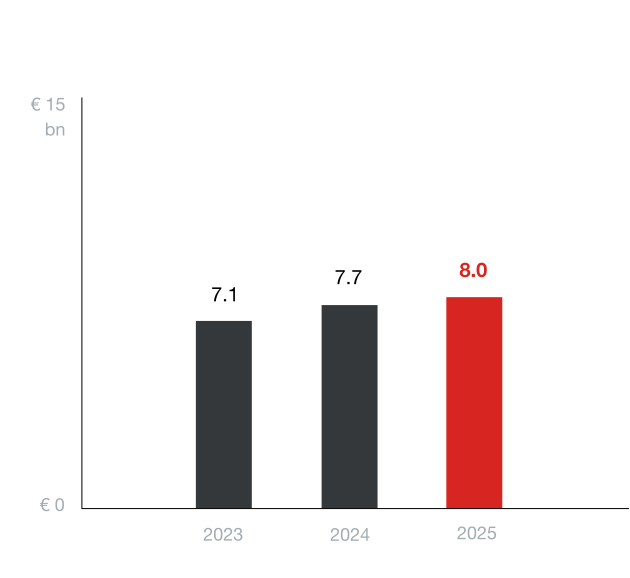
Order backlog | 7,963.12 | 7,738.49 | 3 | 225 |
EBIT | 266.72 | 387.99 | -31 | -121 |
EBIT margin (% of revenue) | 3.7 | 5.4 | ||
Employees (FTE) | 26,218 | 26,852 | -2 | -634 |
Output volume – South + East segment
€ mn | 2025 | 2024 | Δ 2024-2025 % | Δ 2024-2025 absolute |
|---|---|---|---|---|
Austria | 2,407 | 2,479 | -3 | -72 |
Poland | 1,747 | 1,571 | 11 | 176 |
Czech Republic | 1,086 | 995 | 9 | 91 |
Hungary | 577 | 577 | 0 | 0 |
Germany | 486 | 540 | -10 | -54 |
Romania | 440 | 428 | 3 | 12 |
Slovakia | 305 | 292 | 4 | 13 |
Croatia | 251 | 222 | 13 | 29 |
Slovenia | 138 | 89 | 55 | 49 |
Serbia | 107 | 92 | 16 | 15 |
Bulgaria | 76 | 48 | 58 | 28 |
Other countries | 74 | 169 | -56 | -95 |
Total | 7,694 | 7,502 | 3 | 192 |
Output, revenue and EBIT
Strong growth in Poland and Czech Republic
Output in the segment South + East increased by 3% to € 7,694.14 million in the 2025 financial year, driven mainly by strong output growth in Poland and the Czech Republic. Austria showed nearly stable development despite a weak market for residential construction and constrained municipal budgets.
Revenue amounted to € 7,238.46 million and, with a plus 2%, increased somewhat less strongly than output. EBIT declined in the reporting year to € 266.72 million (2024: € 387.99 million), corresponding to an EBIT margin of 3.7% (2024: 5.4%). While earnings improvements were achieved in several countries in Eastern and South-East Europe, the strong results of the previous year could not be repeated in Austria and Hungary, among other markets. In Austria, the financial situation of municipalities remains strained, while in Hungary EU funds remain frozen. Earnings in Austria were also burdened by the impact from the cartel proceedings (modification proceedings), which have since been brought to a legally binding close.
Output volume
Order backlog
Order backlog
Dynamic infrastructure sector in CEE
The order backlog increased by 3% year-on-year to € 7,963.12 million. The Czech Republic contributed most strongly to this growth, driven by the successful acquisition of several mobility infrastructure projects, especially in railway construction. Hungary, Poland and Slovenia also recorded noticeable increases, carried by a broad mix of projects in several construction sectors.
Employees
The number of employees declined slightly by 2% to 26,218 FTEs in the 2025 financial year. While Austria saw reductions, Poland and the Czech Republic expanded staff numbers in line with the higher output.
Outlook
Output growth despite diverging trends
Despite diverging trends, a solid increase in output is expected in the South + East segment for 2026, based on the high order backlog.
In Austria, building construction remains under pressure due to the weak residential construction market in recent years and the overall challenging conditions for construction in the country, which are dampening the willingness of industry to invest. In the transportation infrastructure business, the strained municipal budgets are particularly noticeable and government austerity measures in response to the budget deficit are likely to further curb tendering activity in this area. By contrast, the consistently high levels of investment by ASFINAG and ÖBB are having a stabilising effect. Positive momentum is being generated by Reconstruction, Conversion & Refurbishment as well as by investments in energy infrastructure and the construction of data centres. Additional market opportunities are arising in specialist services and in projects relating to climate-resilient urban development and land unsealing.
In Poland, the release of EU funding has led to a perceptible increase in public investment activity, particularly in mobility infrastructure. Tender volumes in rail and road construction have risen significantly and further large-scale projects are expected in energy and defence infrastructure. With the acquisition of ZABERD, STRABAG has also positioned itself as a leading company in the field of road maintenance. In building construction, private investment remains subdued for the time being, with public investment partially offsetting this trend. The interest rate cuts already implemented are expected to provide additional growth stimulus from 2026 onwards.
The situation in Hungary remains challenging due to withheld EU funds and lower public investment activity in the run-up to the 2026 parliamentary elections. Positive developments can be seen in contracts from the automotive manufacturing industry and its suppliers as well as in foreign direct investment in battery technology and digital services. In the coming years, investments are also expected in road, water and energy infrastructure.
In the Czech Republic, a significant increase in tender volumes can be observed in transportation infrastructure. The rail sector in particular is showing positive market momentum, with further tenders totalling around € 3.6 billion planned for 2026. The tender situation in energy and water infrastructure is also developing favourably. Against the backdrop of declining interest and inflation rates, increasing private investment activity can be expected.
In Slovakia, increased investment in transportation infrastructure is anticipated from 2026 onwards in connection with the upcoming municipal elections, although noticeable competitive and price pressure persists, particularly in this area. Several large-scale projects are expected to be put out to tender in rail and bridge construction, including schemes structured as public-private partnerships. In building construction, a recovery is anticipated in industrial and residential construction.
Overall, the development of demand in the markets of South-East Europe show varying tendencies but, taken together, point to stable development. In Croatia, supported by EU funding, the current focus is on energy, water and mobility infrastructure, with particular emphasis on rail construction. In Slovenia, record-high government spending combined with EU-backed investment programmes is creating stable growth stimulus for the construction sector, especially in infrastructure and residential construction. Romania continues to be regarded as a promising growth market with considerable infrastructure needs, some of which are supported by EU-financed investment. At present, fiscal policy measures aimed at reducing the budget deficit are having a dampening effect. In South-East Europe’s markets, an increased presence of competitors can be observed from outside Europe, for example from China and Turkey.
The building materials activities that are bundled in the South + East segment are showing a satisfactory trend overall. These activities are of key importance for the action area of circularity in our Strategy 2030.
Selected projects – South + East segment
Country | Project | Order backlog in € mn | As % of total Group order backlog |
Slovakia | F.D. Roosevelt Hospital | 257 | 0.8 |
Czech Republic | Railway junction at Česká Třebová | 224 | 0.7 |
Poland | Maksymilianowo railway junction | 160 | 0.5 |
Poland | DK12 Głogów bypass | 151 | 0.5 |
Slovenia | Emonika City Centre (southern part) | 126 | 0.4 |
Segment International + Special Divisions
The International + Special Divisions segment comprises the majority of STRABAG SE’s non- European business in addition to its global tunnelling activities. The segment also encompasses infrastructure development, real estate development, energy infrastructure and building solutions, irrespective of where these are performed, and includes the divisions United Kingdom, Australia and STRABAG Hold Estate (real estate portfolio management).
€ mn | 2025 | 2024 | Δ 2024-2025 % | Δ 2024-2025 absolute |
Output volume | 4,030.13 | 3,268.68 | 23 | 761 |
Revenue | 3,944.87 | 3,059.27 | 29 | 886 |
Order backlog | 9,981.89 | 5,505.02 | 81 | 4,477 |
EBIT | 181.69 | -2.28 | n.a. | 184 |
EBIT margin (% of revenue) | 4.6 | -0.1 | ||
Employees (FTE) | 22,796 | 21,255 | 7 | 1,541 |
Output volume – International + Special Divisions segment
€ mn | 2025 | 2024 | Δ 2024-2025 % | Δ 2024-2025 absolute |
|---|---|---|---|---|
Germany | 1,076 | 1,094 | -2 | -18 |
Australia | 578 | 0 | n.a. | 578 |
Americas | 526 | 514 | 2 | 12 |
United Kingdom | 518 | 681 | -24 | -163 |
Austria | 405 | 280 | 45 | 125 |
Middle East | 259 | 252 | 3 | 7 |
Poland | 156 | 106 | 47 | 50 |
Italy | 134 | 107 | 25 | 27 |
Czech Republic | 94 | 6 | >100 | 88 |
Asia | 91 | 103 | -12 | -12 |
Benelux | 76 | 76 | 0 | 0 |
Romania | 25 | 5 | >100 | 20 |
Africa | 24 | 8 | >100 | 16 |
Slovakia | 19 | 10 | 90 | 9 |
Rest of Europe | 16 | 13 | 23 | 3 |
Croatia | 13 | 0 | n.a. | 13 |
Sweden | 13 | 0 | n.a. | 13 |
Slovenia | 5 | 3 | 67 | 2 |
Switzerland | 2 | 3 | -33 | -1 |
Hungary | 0 | 8 | -100 | -8 |
Total | 4,030 | 3,269 | 23 | 761 |
Output, revenue and EBIT
Significant output growth
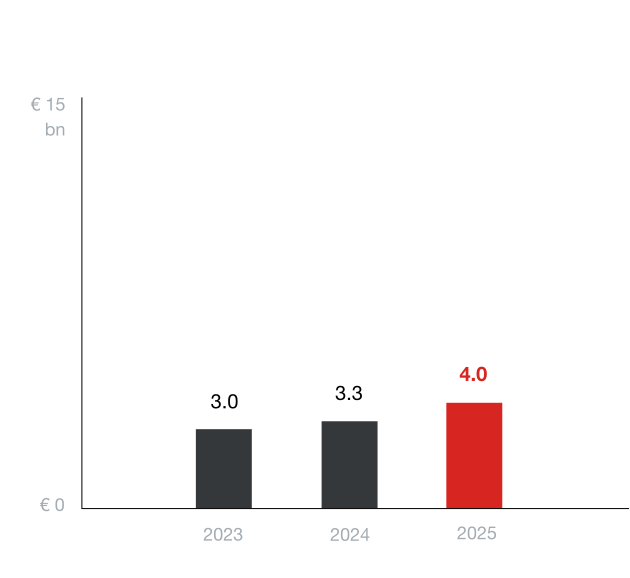
Output in the segment International + Special Divisions rose sharply by 23% to € 4,030.13 million in 2025. The acquisition of Georgiou Group in Australia was the main contributor to this development. Among the core markets, the greatest increases were recorded in Austria, the Czech Republic and Poland – in different sectors depending on the country. Noteworthy business areas include building solutions, real estate project development and tunnelling. In the United Kingdom, the deferral of output portions from major projects to subsequent years resulted in a decline.
Revenue increased more strongly than output year on year, growing by 29% to € 3,944.87 million. The International + Special Divisions segment is subject to regular fluctuations due to large and mega-sized projects. In the 2025 financial year, lower earnings charges were recorded in the volatile international project business. Higher earnings contributions from the infrastructure development and building solutions business, as well as initial profit contributions from Australia, also had a positive impact. EBIT amounted to € 181.69 million (2024: € -2.28 million), corresponding to a solid EBIT margin of 4.6%.
Output volume
Order backlog
Order backlog
Order backlog driven by UK and Australia
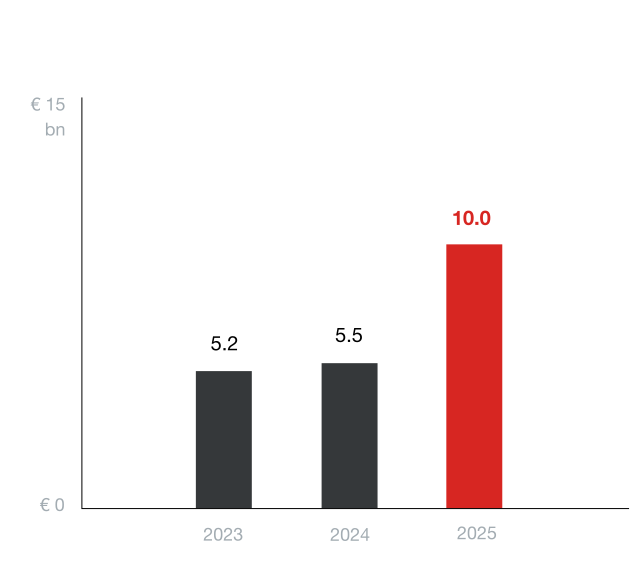
The order backlog as at 31 December 2025 surged by 81% year-on-year to € 9,981.89 million. The strongest increases were recorded in the United Kingdom – driven by the acquisition of the HARP water infrastructure megaproject – and in Australia due to the takeover of Georgiou Group. Further significant increases in the order backlog were recorded especially in the Middle East, but also in the Czech Republic and in various sectors in Austria.
Employees
The number of employees in the segment International + Special Divisions grew by 7% to 22,796 FTEs, around half of which is attributable to the Australian acquisition with more than 800 employees. In existing markets, employee numbers were increased to implement newly acquired projects, particularly in the Middle East, Austria and the Czech Republic.
Outlook
Substantial output growth expected
For the 2026 financial year, the International + Special Divisions segment is expected to achieve substantial output growth on the back of a significantly higher order backlog.
The tunnelling business is subject to regular fluctuations due to the project sizes in this sector. Major projects are currently being executed in Canada and the United Kingdom. A large number of projects in Germany, together with smaller contracts in Italy, the Czech Republic, Slovenia, Croatia and Austria, are ensuring stable capacity utilisation.
The focus of the international business is on established markets in the Middle East (United Arab Emirates, Oman and Qatar) and in South America (Chile). The short- and medium-term outlook remains optimistic. In mining, the order backlog was significantly expanded through another major contract in Chile, while in the Middle East a large-scale building construction project and road construction schemes in Oman are ensuring good utilisation. Decarbonisation projects and strong demand for raw materials in these regions are also creating growth opportunities.
On 28 February 2026, the United States and Israel launched air strikes on Iran, prompting Iranian counterattacks in the region. STRABAG does not operate in Iran, but it is active in Qatar, the United Arab Emirates and Oman. Following the acquisition of WTE Wassertechnik GmbH, the Group now also has operations in Bahrain and Kuwait. At the time this report was being prepared, no damage to the company’s facilities had been recorded in these regions. In line with official recommendations, activities were temporarily suspended or significantly reduced. The medium-term impact of the war – for example due to rising energy prices – cannot yet be assessed at the time of reporting.
In the United Kingdom, where STRABAG has been successfully active in the project business for many years, the development of a permanent local presence is progressing according to plan. Long-term contracts in the public and private sectors are intended to open up future growth opportunities in mobility, water and energy infrastructure and, more recently, in building construction.
In Australia, the integration of Georgiou Group, acquired in March, is currently under way. Demand for construction services remains stable, with foreseeable order declines in New South Wales likely to be largely offset by a rising number of major projects in Western Australia and Queensland. In addition to announced large-scale investments in state energy infrastructure, the 2032 Summer Olympics in Brisbane are expected to significantly increase demand for construction services between 2026 and 2030.
The Energy Infrastructure entity secured several significant contracts in 2025, including the construction of the world’s largest heat pump in Mannheim. For 2026, continued dynamic market development is expected in energy and water infrastructure, driven in particular by Europe-wide efforts to achieve climate targets and by national investment programmes. With the closing of WTE Wassertechnik GmbH in March 2026, STRABAG is becoming a full-service provider in integrated water management. Supported by further inorganic growth, value creation depth is to be increased further.
In March 2025, Building Solutions acquired Instalace Praha, a Czech M&E specialist with around 280 employees. Further acquisitions are being pursued in Austria, Germany and Central and Eastern Europe in order to expand Group-wide M&E expertise. By linking the facility management business with M&E capabilities, the business unit is developing into a full-service provider for decarbonisation and sustainable building operations.
In Infrastructure Development, one focal project is the Haweswater Aqueduct Resilience Programme (HARP) in the United Kingdom, which reached financial close in the reporting year. In line with Strategy 2030, photovoltaic and battery energy storage projects are being developed to increase the share of renewable energy in Germany. In addition, a portfolio of large-scale photovoltaic projects is being established in Colombia and further concession projects are being pursued in the Group’s core markets.
In Real Estate Development, the expected economic upturn in Germany and Austria suggests that the market trough is likely to have been passed, although a marked recovery in commercial property transactions is not anticipated before 2027. At the same time, a supply gap is emerging, particularly for sustainable commercial properties and affordable housing, alongside consolidation within the developer and property development sector. STRABAG has strengthened its activities, particularly in residential and residential-related asset classes, thereby positioning itself more resiliently.
Over the past three years, STRABAG Hold Estate has successfully established itself in the market and is expanding the Group’s service portfolio to include the long-term, strategic holding of non-operating properties. Following acquisitions primarily in Germany and Austria in the office, residential and hotel asset classes, the focus is now shifting to Central and Eastern Europe.
Selected projects – International + Special Divisions segment
Country | Project | Order backlog in € mn | As % of total Group order backlog |
United Kingdom | Haweswater Aqueduct Resilience Programme (HARP) | 2,636 | 8.4 |
United Kingdom | HS2 high-speed rail line | 1,327 | 4.2 |
United Kingdom | Woodsmith Project | 274 | 0.9 |
Canada | Scarborough Subway Extension Line 2 | 207 | 0.7 |
Australia | Tonkin Extension | 169 | 0.5 |
Segment Other
Service companies and central staff divisions
This segment encompasses the Group’s internal central divisions and central staff divisions.
€ mn | 2025 | 2024 | Δ 2024-2025 % | Δ 2024-2025 absolute |
Output volume | 168.67 | 227.96 | -26 | -59 |
Revenue | 19.08 | 17.92 | 6 | 1 |
Order backlog | 15.85 | 30.82 | -49 | -15 |
EBIT | -8.93 | 0.74 | n.a. | -10 |
EBIT margin (% of revenue) | -46.8 | 4.1 | ||
Employees (FTE) | 8,036 | 7,675 | 5 | 361 |