Segment Report
Segment North + West
The North + West segment delivers construction services of nearly any kind and size with a focus on Germany, Switzerland, the Benelux countries and Scandinavia. Ground engineering can also be found in this segment.
€ mn | 6M/2026 | 6M/2025 | Δ % | Δ absolute |
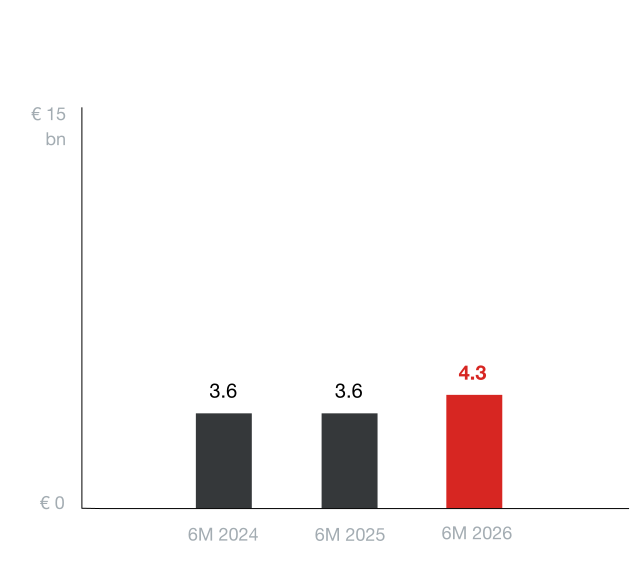
Output volume | 4,291.83 | 3,640.49 | 18 | 651 |
Revenue | 3,758.31 | 3,134.54 | 20 | 624 |
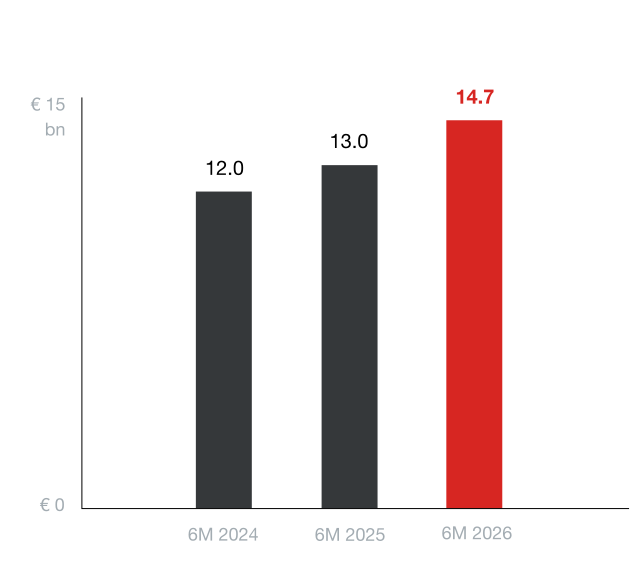
Order backlog | 14,748.44 | 12,999.89 | 13 | 1,749 |
EBIT | 182.28 | 83.38 | 119 | 99 |
EBIT margin (% of revenue) | 4.9 | 2.7 | ||
Employees (FTE) | 23,837 | 23,070 | 3 | 767 |
Output, revenue and EBIT
Strong increase in output
The North + West segment recorded a strong increase in output in the first half of 2026, rising to € 4,291.83 million (+18% compared to 6M/2025). Growth was achieved across all business areas in the home market of Germany, the segment’s largest market. The strongest growth momentum came from energy infrastructure, rail and bridge construction as well as public and private building construction. Output also increased in Sweden and Switzerland, although to a lesser extent given Germany’s relative size within the segment.
Revenue increased by 20% to € 3,758.31 million, slightly outpacing output due to the higher proportion of projects delivered independently rather than through joint ventures. EBIT rose by 119% to an exceptionally high € 182.28 million. This was driven primarily by higher earnings contributions from infrastructure construction in Germany, particularly in the areas of transport and energy infrastructure.
Output volume
Order backlog
Order backlog
Germany driving growth
As of 30 June 2026, the order backlog increased by a further 13% to € 14,748.44 million. This was driven primarily by the positive performance in the home market of Germany in both transportation infrastructures and in building construction and civil engineering. Major infrastructure projects provided the strongest impetus. Sweden also recorded an increase in the order backlog, while ongoing project execution in the Benelux countries and Switzerland led to a decline.
Employees
The number of employees in the segment increased by 3% year on year to 23,837 FTEs. Supported by the positive order trend and the acquisition of the Stumpp Group, headcount increased particularly in Germany.
Outlook
Significant output growth expected
Based on the further increase in the order backlog, STRABAG expects to see significant growth of output in the North + West segment in 2026 despite some challenging market conditions.
In Germany, the construction industry is showing signs of recovery across all sectors for the first time in five years. Key drivers include the high volume of tenders issued by Deutsche Bahn and the € 11 billion federal roads budget for 2026. Additional growth momentum is expected from rising demand driven by the energy transition, the healthcare sector and military infrastructure projects, the latter benefiting in particular from increased defence spending.
At the same time, insufficient municipal budgets, persistently intense price competition and rising prices for petroleum-based products remain significant challenges. If planning and approval procedures can be accelerated, including through alternative contract models, the € 500 billion off-budget infrastructure fund provided by the German federal government could begin to stimulate demand from late 2026 or early 2027 at the earliest.
Following the sharp declines of recent years, the residential construction market is showing initial signs of recovery. Although private households and property developers remain cautious owing to uncertainty surrounding the funding landscape and continuing geopolitical risks, investment is expected to increase as a result of the Special Fund for Infrastructure and Climate Neutrality.
Competitive pressure remains intense in the Benelux countries. STRABAG continues to respond to this market environment with a highly selective bidding strategy. In the Netherlands and Belgium, the Group sees opportunities in industrial construction, particularly in projects related to the energy transition. Demand in the residential construction market is also showing a slight increase.
In Scandinavia, the consolidation and stabilisation measures already initiated are continuing. STRABAG’s focus remains on medium-sized projects, primarily in commercial and industrial construction.
In Switzerland, demand for construction services remains stable. The necessary investments have been made to continue pursuing the growth strategy already underway.
Segment South + East
The geographic focus of the segment South + East is on Austria, Poland, the Czech Republic, Slovakia, Hungary, Romania and South-East Europe. The construction materials activities are also handled within this segment.
€ mn | 6M/2026 | 6M/2025 | Δ % | Δ absolute |
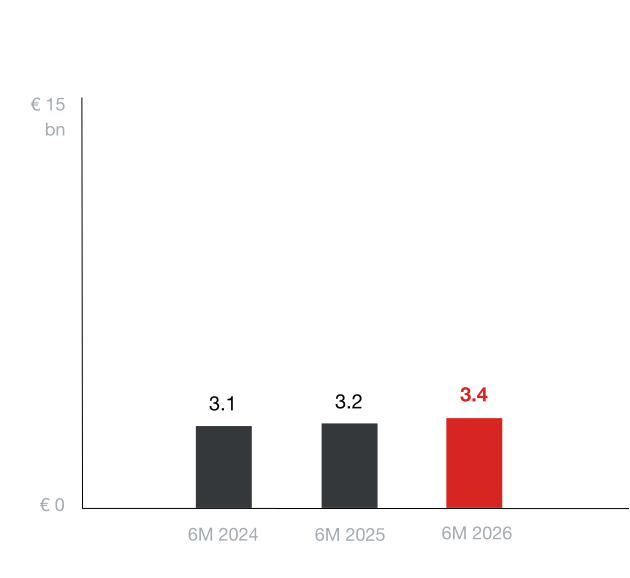
Output volume | 3,367.08 | 3,184.46 | 6 | 183 |
Revenue | 3,189.22 | 3,019.39 | 6 | 170 |
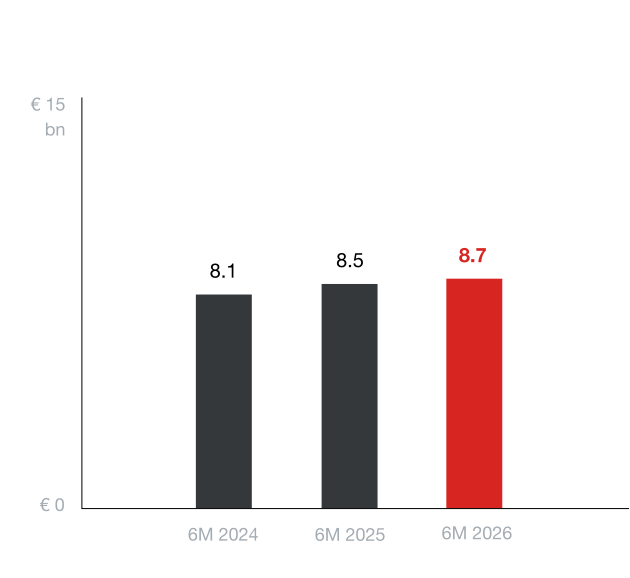
Order backlog | 8,671.74 | 8,534.95 | 2 | 137 |
EBIT | -67.73 | -72.21 | 6 | 4 |
EBIT margin (% of revenue) | -2.1 | -2.4 | ||
Employees (FTE) | 25,316 | 25,538 | -1 | -222 |
Output, revenue and EBIT
Growth in CEE and SEE
The South + East segment generated output of € 3,367.08 million in the first half of 2026, an increase of 6%. Broad-based growth was achieved primarily in the Czech Republic and Croatia. The main drivers were infrastructure, building construction and civil engineering.
The segment’s revenue increased by 6% year on year, in line with output. Despite the later start of road construction projects in key markets of the segment due to cold weather in the first quarter, EBIT was less negative at € -67.73 million (6M/2025: € -72.21 million). The segment typically reports negative earnings in the first half of the year due to its higher proportion of transportation infrastructure projects. Thanks to its broad geographical presence, the weather-related declines were offset by growth in several countries in Eastern and South-East Europe.
Output volume
Order backlog
Order backlog
Infrastructure provides positive momentum
The order backlog stood at € 8,671.74 million at mid-year 2026, representing a year-on-year increase of 2%. Transportation infrastructure and civil engineering projects made the largest contribution to order growth. Geographically, the strongest increases were recorded in Slovenia, Austria and Poland. The order backlog declined in Croatia and Slovakia as major projects progressed.
Employees
The number of employees in the segment remained largely stable in the first half of 2026 at 25,316 FTEs. Headcount was increased primarily in Poland, Croatia, Romania and the Czech Republic to support project delivery. By contrast, employee numbers declined in Austria and Hungary.
Outlook
Higher output despite diverging market trends
Despite diverging market trends, a solid increase in output is expected in the South + East segment for 2026, supported by the high order backlog.
In Austria, construction output is expected to remain broadly stable in 2026. Building construction remains under pressure due to the weak residential construction market in recent years and the overall challenging conditions in the country, which are weighing on industrial investment. In transportation infrastructures, constrained municipal budgets and government spending cuts are expected to continue dampening tender activity. By contrast, the consistently high levels of investment by ASFINAG and ÖBB are having a stabilising effect. Positive momentum is being generated by refurbishment and renovation projects, investments in energy and utility infrastructure, and the construction of data centres. Additional market opportunities are emerging in specialist construction services and projects aimed at developing climate-resilient urban infrastructure.
In Poland, sustained high levels of public investment continue to drive a noticeable upturn in the infrastructure market, particularly in mobility. Tender volumes in rail and road construction have risen significantly and further large-scale projects are expected in energy and defence infrastructure. Investment in building construction is also beginning to recover gradually following the subdued market conditions of recent years. To capitalise on the anticipated increase in investment over the coming years, STRABAG is pursuing targeted acquisitions to expand and deepen its value chain.
In Hungary, the market environment is expected to improve somewhat following the change of government and the partial release of EU funding. Public investment activity, however, continues to be constrained by the conditions attached to the release of these funds, the subdued economic environment and the country’s strained public finances. Positive developments include contracts from the automotive manufacturing industry and its suppliers, as well as foreign direct investment in battery technology and digital services. Further investment in road, water and energy infrastructure is also expected over the coming years.
In the Czech Republic, tender volumes in transportation infrastructures remain at a high level. The rail sector in particular continues to show positive market momentum, with tenders worth around € 3.6 billion planned for 2026. In addition, the Czech building construction market is becoming increasingly important for STRABAG.
In Slovakia, investment in transportation infrastructures is expected to increase from 2026 onwards in the run-up to the municipal elections, although this market in particular continues to be characterised by intense competitive and pricing pressure. Several major rail and bridge construction projects are expected to be tendered, including schemes to be delivered as public-private partnerships (PPP). In building construction, a recovery is anticipated in both the industrial and residential sectors.
In South-East Europe, rail construction and defence infrastructure are becoming increasingly important areas of business. While cross-border rail links are being expanded in the Western Balkans, rising investment in military dual-use infrastructure can be observed in the region’s NATO member states. At the same time, the region is also seeing a growing presence of competitors from outside Europe, particularly from China and Turkey. The increasing emphasis on EU-compliant procurement procedures and environmental and social standards in EU- and IFI-funded projects is a positive development.
In Croatia, supported by EU funding, the current focus is on mobility infrastructure, with particular emphasis on rail construction. In Slovenia, high levels of public spending combined with EU-backed investment programmes are generating stable growth momentum for the construction sector, particularly in infrastructure and residential construction. Romania remains a promising growth market with substantial infrastructure investment needs. These are being addressed, among other measures, through EU-funded investment programmes that are also supporting the rapidly expanding rail infrastructure market. To strengthen its market position, STRABAG in June 2026 announced the planned acquisition of rail construction specialist BAWI Construction, which generates annual output of around € 60 million. At the same time, market development is being constrained by fiscal measures aimed at reducing the government budget deficit.
The building materials activities bundled within the South + East segment continue to show a stable overall trend despite increased price volatility and are of strategic importance to the circular economy action area under Strategy 2030.
Segment International + Special Divisions
The International + Special Divisions segment comprises the majority of STRABAG SE’s non-European business in addition to its global tunnelling activities. The segment also encompasses infrastructure development, real estate development, energy infrastructure and building solutions, irrespective of where these are performed, and includes the divisions United Kingdom, Italy, Australia and STRABAG Hold Estate (real estate portfolio management).
€ mn | 6M/2026 | 6M/2025 | Δ % | Δ absolute |
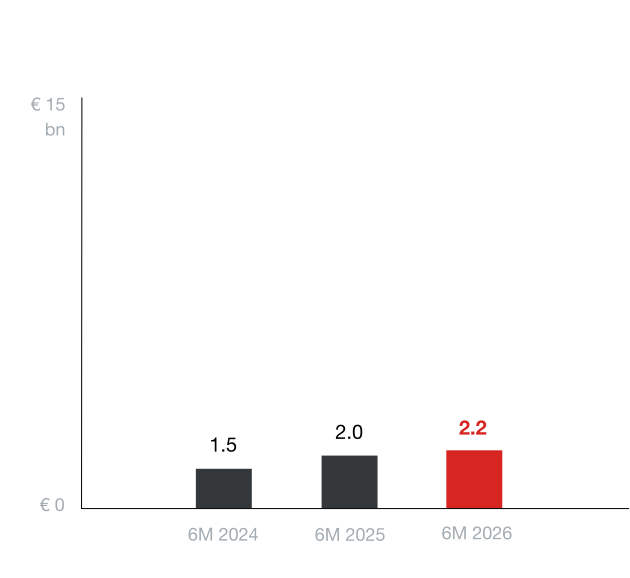
Output volume | 2,233.34 | 1,992.65 | 12 | 241 |
Revenue | 2,190.89 | 1,790.49 | 22 | 400 |
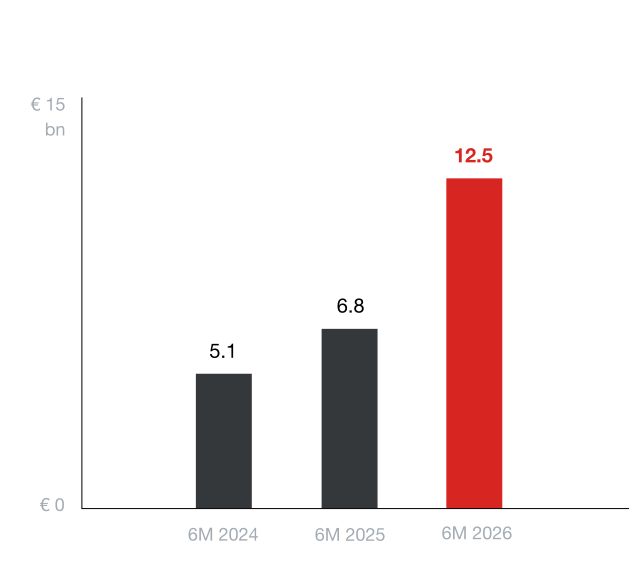
Order backlog | 12,538.22 | 6,811.49 | 84 | 5,727 |
EBIT | 79.47 | 126.89 | -37 | -47 |
EBIT margin (% of revenue) | 3.6 | 7.1 | ||
Employees (FTE) | 23,492 | 22,610 | 4 | 882 |
Output, revenue and EBIT
Organic and inorganic growth
The International + Special Divisions segment generated output of € 2,233.34 million in the first half of 2026, an increase of 12%. The strongest growth was recorded in the United Kingdom and in the energy infrastructure business. This was supported by the acquisitions of Van Elle, one of the UK’s leading ground engineering companies, and the WTE Group, an established European developer, constructor and operator of water infrastructure. Australia and infrastructure development also contributed to the increase in output.
Revenue increased by 22% to € 2,190.89 million, significantly more strongly than the growth in output. The difference resulted from the acquisition of Australia’s Georgiou Group, completed in the previous year: its output was already included for the entire comparative period, whereas its revenue was only recognised from the closing in March. The segment’s EBIT stood at € 79.47 million, compared with € 126.89 million in the first half of 2025. The decline was attributable to a € 50 million impairment of goodwill in connection with an acquisition. Adjusted for this effect, the segment delivered a solid earnings contribution. Higher earnings contributions were recorded in particular in infrastructure and real estate project development as well as in the Building Solutions business.
Output volume
Order backlog
Order backlog
Strong order growth
The segment’s order backlog increased sharply year on year by 84% to € 12,538.22 million as of 30 June 2026. The principal drivers were the award of the HARP water infrastructure megaproject in the United Kingdom, major tunnelling and mining contracts in Germany and Chile, and large-scale rail projects in Australia. The strong increase in the order backlog was driven predominantly by newly awarded projects, while acquisitions made only a minor contribution.
Employees
The number of employees in the International + Special Divisions segment increased by 4% to 23,492 FTEs. The increase reflects both positive business performance and inorganic growth and was particularly evident in the United Kingdom, the Middle East and India, where the acquisition of M&E services engineering specialist Orbittal contributed to higher headcount. In the Americas, headcount declined as major projects progressed.
Outlook
Substantial output growth expected
The International + Special Divisions segment expects a substantial increase in output in 2026, supported by its significantly higher order backlog.
The tunnelling business is characterised by regular fluctuations due to size of individual projects in this sector. Following the award of several major contracts, the current order backlog is at a high level. Major projects are currently being delivered in Canada and the United Kingdom, while numerous projects in Germany, together with smaller contracts in Italy, the Czech Republic, Croatia and Austria, are ensuring stable capacity utilisation.
The international business continues to focus on its long-established markets in the Middle East (United Arab Emirates and Oman) and South America (Chile). In South America, contracts in the mining sector in particular are ensuring a high level of capacity utilisation. The short- and medium-term outlook remains positive.
At the end of February 2026, the United States and Israel launched air strikes against Iran, which were followed by Iranian retaliatory attacks across the region. STRABAG has no operations in Iran, but it is active in the United Arab Emirates and Oman. Following the acquisition of WTE Wassertechnik GmbH, Kuwait has been added as a further market. At the time of preparing this report, no damage to the Group’s facilities had been reported in these regions. While ongoing projects have so far experienced only limited disruption, delays in contract awards could weigh on business development in the region. At the time of reporting, it is not yet possible to reliably assess the medium-term consequences of the conflict, including the potential impact of higher energy prices.
In the United Kingdom, where STRABAG has successfully delivered project-based business for more than a decade, the expansion of its regional operating business is progressing as planned. Long-term contracts in both the public and private sectors are expected to create future growth opportunities in mobility, water and energy infrastructure as well as in building construction. The acquisition of Van Elle, one of the UK’s leading ground engineering companies, strengthens STRABAG’s expertise while deepening its value chain through the combination of complementary capabilities in building construction and infrastructure.
In Australia, the integration of Georgiou Group is progressing according to plan. Demand for construction services is developing as expected, enabling the order backlog to exceed € 1 billion for the first time. Several major transport infrastructure projects secured through joint ventures underline Georgiou’s growing competitiveness as part of STRABAG. Additional growth opportunities are expected from announced investments in energy infrastructure, the mining sector and infrastructure projects associated with the Brisbane 2032 Olympic Games, which are likely to further stimulate demand for construction services, particularly between 2026 and 2030.
In Energy Infrastructure, market development in the energy and water infrastructure sectors is expected to remain dynamic in 2026. This will be driven primarily by Europe-wide efforts to achieve climate targets, investment in the expansion and modernisation of water infrastructure, and national investment programmes. With the closing of the acquisition of WTE Wassertechnik GmbH in March 2026, STRABAG has become a full-service provider of integrated water management solutions. Supported by further inorganic growth, the Group intends to continue expanding the depth of its value creation.
By combining facility management and M&E expertise, Building Solutions is further strengthening its position as a full-service provider for building decarbonisation and sustainable building operations. Demand for energy management solutions continues to grow in response to high energy prices. At the same time, balancing cost pressures on the customer side with high quality standards and the availability of qualified personnel remains challenging. To further develop and expand the Group’s M&E capabilities, STRABAG is pursuing acquisitions in Austria, Germany and Central and Eastern Europe.
Within Infrastructure Development, one key project is the Haweswater Aqueduct Resilience Programme (HARP) in the United Kingdom. In line with Strategy 2030, the Group is also increasingly developing and delivering photovoltaic, wind energy and battery energy storage system (BESS) projects in Germany and Colombia, while continuing to advance further concession projects across its core markets.
In Real Estate Development, the anticipated economic recovery in Germany and Austria is expected to mark the end of the market downturn, although a significant recovery in commercial real estate transactions is not expected before 2027. At the same time, a supply shortage is becoming increasingly apparent, particularly in the affordable housing segment, while consolidation among developers and property companies continues. STRABAG has expanded its activities here primarily in residential and residential-related asset classes.
Over recent years, STRABAG Hold Estate has established a strong market position and has broadened the Group’s service portfolio to include the long-term strategic holding of non-operational real estate assets. Following acquisitions in the office, residential and hotel asset classes, primarily in Germany and Austria, the future focus will shift towards Central and Eastern Europe, with an increased emphasis on residential properties. The acquisition of the Olivia Star landmark office tower in Gdańsk marked the Group’s entry into the Polish market in July 2026.
Segment Other
Service companies and central staff divisions
This segment encompasses the Group’s internal central divisions and central staff divisions.
€ mn | 6M/2026 | 6M/2025 | Δ % | Δ absolute |
Output volume | 90.42 | 87.59 | 3 | 3 |
Revenue | 9.66 | 8.18 | 18 | 1 |
Order backlog | 26.82 | 19.89 | 35 | 7 |
EBIT | 0.51 | 0.51 | 0 | 0 |
EBIT margin (% of revenue) | 5.3 | 6.2 | ||
Employees (FTE) | 8,278 | 7,941 | 4 | 337 |